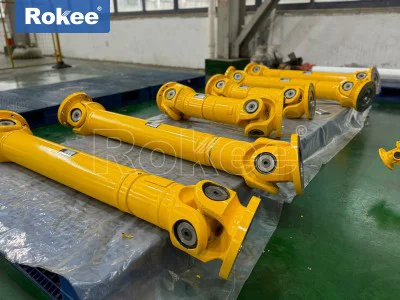
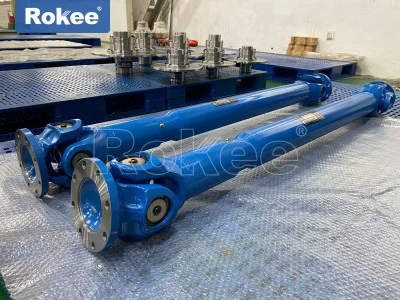
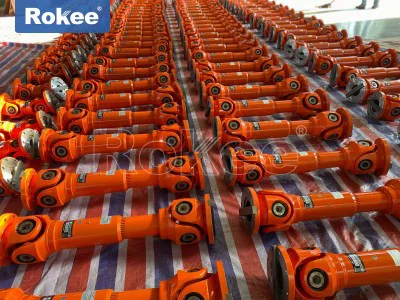
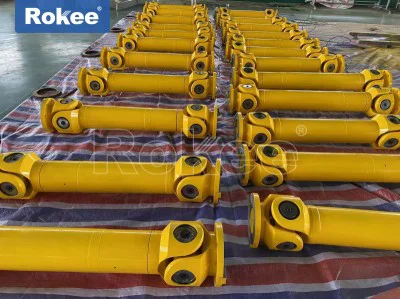
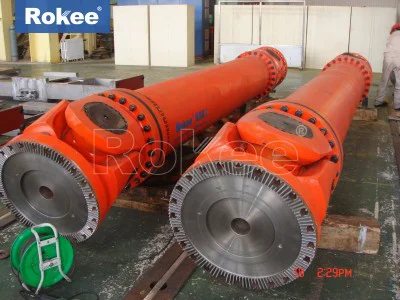
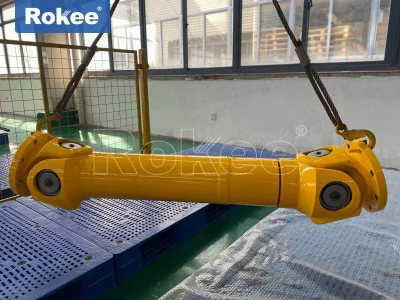
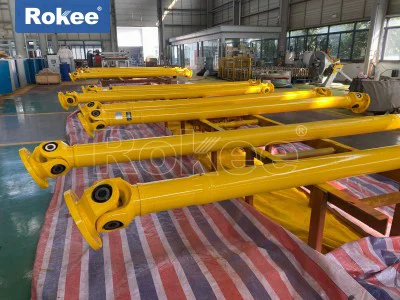
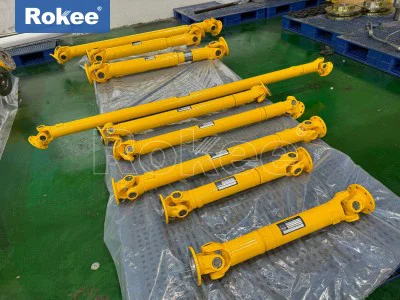
Material Characteristics And Application Scenarios Of Universal Shaft In Rock Wool Sandwich Panel Production Line
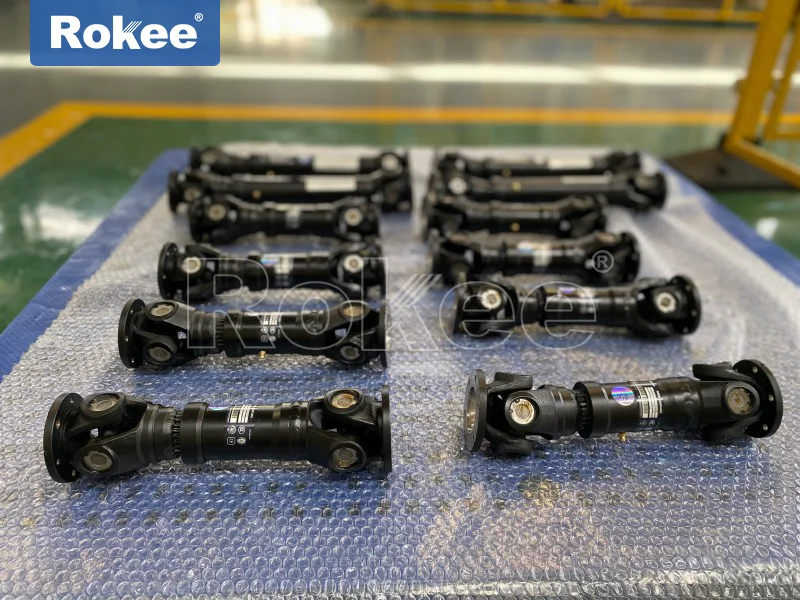
The rock wool sandwich panel production line is a continuous and integrated industrial manufacturing system designed for the mass production of thermal insulation and fireproof building composite panels, which integrates raw material feeding, rock wool fiber forming, panel surface laminating, continuous pressing, edge trimming, and fixed-length cutting into one seamless production process. The entire production operation relies on stable and efficient mechanical transmission to ensure the synchronous coordination of multiple groups of rotating and operating equipment, and the universal shaft, as a core connecting and transmission component between driving devices and driven mechanical parts, undertakes the key task of transmitting torque and rotational power under complex and changeable operating conditions. Unlike ordinary transmission shafts used in conventional light industrial production equipment, the universal shafts matched with rock wool sandwich panel production lines need to adapt to long-term continuous operation, frequent starting and stopping, alternating impact loads, and minor installation misalignment caused by equipment vibration and thermal deformation in the production environment. The unique material characteristics of universal shafts directly determine their transmission stability, service life, and maintenance cycle in the actual production process, and also restrict the overall operating efficiency and continuous production capacity of the entire rock wool sandwich panel production line. Understanding the inherent material properties of universal shafts and their matching application scenarios in each production link is essential for optimizing the equipment operation configuration, reducing mechanical failure rates, and maintaining long-term stable and high-efficiency operation of the rock wool sandwich panel manufacturing system.
The core material selection of universal shafts for rock wool sandwich panel production line focuses on high-strength alloy steel as the base raw material, with 42CrMo alloy steel being the most widely used and practical base material for the main shaft body and key force-bearing structural parts. This type of alloy steel has been scientifically proportioned with various metal elements during the smelting process, endowing it with comprehensive and excellent mechanical properties that are far superior to ordinary carbon steel and low-alloy steel, fully meeting the harsh mechanical performance requirements of universal shafts in heavy-load and continuous production environments. After strict quenching and tempering heat treatment, the tensile strength of 42CrMo alloy steel used for universal shaft blanks can reach more than 900 megapascals, and the yield strength is maintained within a reasonable range that matches the load demand, ensuring that the shaft body will not undergo permanent deformation or structural fracture even under long-term high-torque transmission and instantaneous impact load conditions. In addition to basic tensile and yield strength, this alloy material has outstanding fatigue resistance, which is a crucial material characteristic for universal shafts working in rock wool sandwich panel production lines that operate uninterruptedly for long hours. The production line runs continuously day and night for most of the production cycle, and the universal shaft needs to bear cyclic alternating torque and repeated mechanical stress for a long time. Ordinary steel materials are prone to fatigue cracks and structural damage after a short period of cyclic stress action, while 42CrMo alloy steel can effectively resist fatigue damage, delay the generation and expansion of internal microcracks, and maintain the structural integrity and dimensional stability of the shaft body during long-term cyclic operation.
Another important material characteristic of the universal shaft base material is excellent plastic reserve and impact toughness, which plays a vital role in adapting to the unstable load fluctuations in the rock wool sandwich panel production process. In the actual production of rock wool sandwich panels, abnormal load fluctuations often occur due to uneven feeding of rock wool raw materials, temporary jamming of panel substrates, and instantaneous speed adjustment of pressing equipment. These unexpected working conditions will generate sudden impact loads on the transmission system, and the universal shaft, as the intermediate transmission connecting part, needs to buffer and absorb part of the impact stress to avoid direct damage to the driving motor, reduction gearbox and other core power equipment. The alloy steel material used for the universal shaft has a reasonable elongation rate and impact energy value after heat treatment, with a low yield ratio that ensures the material has sufficient plastic deformation space before reaching the limit stress state. When encountering instantaneous impact loads, the shaft body can undergo slight and reversible plastic deformation to buffer the impact force, instead of brittle fracture directly like ordinary rigid materials. This material toughness characteristic effectively avoids sudden mechanical breakdowns of the transmission system caused by instantaneous load changes, ensures the continuity of production operations, and reduces unexpected production shutdown losses caused by transmission component damage.
In addition to the inherent mechanical properties of the base alloy material, the surface processing and post-treatment characteristics of the universal shaft material also constitute an indispensable part of its overall material advantages, and are key factors affecting the wear resistance and corrosion resistance of the universal shaft in the production line working environment. The surface of the universal shaft used in rock wool sandwich panel production lines usually undergoes precision forging and advanced surface strengthening treatment processes. The shaft blank is first formed by combining free forging and die forging processes, which makes the internal metal fiber streamline of the material continuous and uniform, avoids internal structural defects such as pores and cracks, and further improves the overall structural strength and stress uniformity of the shaft body. On this basis, the surface of the universal shaft will be processed by precision rolling and strengthening, which can reduce the surface roughness of the shaft to an extremely low level, significantly reduce the friction coefficient between the universal shaft and matching connecting parts such as bearings and universal joints during operation. The surface strengthening treatment can also increase the surface microhardness of the shaft material by more than 20 percent, effectively improving the surface wear resistance of the universal shaft. In the rock wool sandwich panel production workshop, there are a small amount of fine rock wool fiber dust and humid air generated during the production process, which will cause certain abrasive wear and slight atmospheric corrosion to the rotating and operating mechanical parts. The optimized surface material performance of the universal shaft can effectively resist abrasive wear caused by long-term friction and dust erosion, and also enhance the atmospheric corrosion resistance of the shaft body, avoiding surface rust, material peeling and other problems that affect transmission accuracy and service life.
The structural matching characteristics derived from the material performance of the universal shaft also make it have unique adaptability to the special transmission connection requirements of the rock wool sandwich panel production line. Different from rigid fixed transmission shafts, the universal shaft made of high-quality alloy materials has a certain structural deformation coordination ability while ensuring overall rigidity. The material can maintain stable transmission performance under the working conditions of small axial displacement, radial deflection and angular misalignment between the driving end and the driven end of the equipment. During the long-term operation of the rock wool sandwich panel production line, the frame of each equipment module will have slight displacement and deformation due to long-term vibration and thermal expansion and contraction generated by the heating and pressing process of rock wool panels. The rigid transmission shaft cannot adapt to this small installation and operation misalignment, which will lead to increased transmission resistance, accelerated component wear, and even shaft body fracture. The universal shaft, relying on the comprehensive mechanical characteristics of its alloy material, can automatically compensate for the misalignment deviation generated during equipment operation, maintain stable torque transmission in a non-coaxial operating state, and ensure the synchronous operation of front and rear transmission equipment without additional mechanical adjustment and maintenance operations.
The feeding and preliminary fiber forming link of rock wool raw materials is one of the most basic and core application scenarios of universal shafts in the entire production line. In this production stage, bulk rock wool raw materials are transported from the raw material silo to the fiber opening and dispersing equipment through the conveyor system, and the power of the conveyor rollers and fiber dispersing rotors needs to be transmitted by universal shafts connected with the reduction motor. This working scenario has the characteristics of stable long-term load, continuous uninterrupted operation and occasional material accumulation and jamming impact. The high fatigue resistance and impact toughness of the universal shaft material can fully adapt to the long-term continuous rotating transmission work here, and cope with the instantaneous impact load generated when raw materials are jammed. The universal shaft connects the power output end of the motor and the rotating shaft of the conveyor roller, effectively solving the installation misalignment problem caused by the separate installation of the motor and the conveyor equipment frame. The excellent wear resistance of the shaft surface material can resist the abrasion of fine rock wool fiber dust on the rotating friction parts, ensuring that the feeding and fiber forming link maintains a stable transmission state for a long time, avoiding uneven raw material conveying speed caused by transmission failure, and thus ensuring the uniform forming density of subsequent rock wool fiber layers, which lays a foundation for the consistent quality of finished rock wool sandwich panels.
The continuous composite pressing and bonding forming link of rock wool sandwich panels is the core working link with the heaviest transmission load in the production line, and also the key application scenario where the universal shaft bears the largest torque and the most complex stress changes. In this link, the upper and lower metal surface panels and the middle rock wool fiber core layer are compounded together through high-temperature heating and high-pressure continuous pressing equipment to form an integrated sandwich panel structure. The pressing equipment needs to maintain stable high-pressure clamping force and synchronous rotating operating speed, and the transmission system of the pressing roller set needs to output large torque to ensure the stable progress of composite pressing. The universal shaft used in this link needs to bear heavy-load torque transmission for a long time, and at the same time adapt to the slight thermal deformation of the pressing equipment frame caused by long-term high-temperature heating. The high tensile strength and yield strength of the universal shaft alloy material can fully bear the high-torque transmission demand of the pressing roller set, avoiding structural deformation and damage of the shaft body under heavy load. The material's thermal stability and structural deformation coordination ability can adapt to the small displacement and misalignment of the equipment caused by high-temperature thermal expansion, ensuring the synchronous and consistent rotating speed of the upper and lower pressing rollers. If the transmission component fails here, it will directly lead to uneven pressing of the sandwich panel, inconsistent bonding strength between the panel and the rock wool core layer, and even defective products such as panel deviation and core layer dislocation. The reliable material characteristics of the universal shaft effectively guarantee the pressing forming quality of the sandwich panel and the stable operation of the heavy-load transmission system.
The edge trimming, shaping and fixed-length cutting link of rock wool sandwich panels is an important finishing processing stage in the production line, and the universal shaft here is mainly used for the transmission connection of trimming rollers, traction rollers and cutting power mechanisms. This application scenario has the characteristics of frequent start-stop adjustment, fast speed change and precise transmission synchronization requirements. After the rock wool sandwich panel is pressed and formed, it needs to be pulled steadily by the traction roller set to the trimming and cutting position, and the edge trimming equipment needs to operate synchronously with the traction speed to ensure neat trimming edges of the panel. The fixed-length cutting equipment needs to complete instantaneous cutting actions according to the set panel length, and the transmission system needs to realize rapid start and stop and instantaneous speed adjustment. The universal shaft used in this link relies on the good structural stability and stress response characteristics of its material, which can adapt to frequent start-stop and speed change working conditions without obvious transmission lag and vibration. The high dimensional stability of the shaft material ensures that the transmission accuracy will not be affected by frequent mechanical impact, maintaining the synchronization accuracy between traction, trimming and cutting equipment. This precise transmission coordination effect ensures that the dimensional accuracy of the finished rock wool sandwich panel meets the production standard requirements, reduces the generation of waste products caused by transmission synchronization errors, and improves the finished product rate of the entire production line.
The finished product conveying and stacking link of rock wool sandwich panels is the final application scenario of universal shafts in the production line, which undertakes the transmission work of finished panel conveying rollers and stacking mechanical power components. Although the load of this link is relatively light compared with pressing and forming, it needs to maintain long-term stable low-speed operation and frequent forward and reverse rotation adjustment according to the stacking rhythm. The excellent fatigue resistance and structural durability of the universal shaft material are fully reflected in this scenario. Long-term low-speed rotating operation and frequent forward and reverse rotation will not cause rapid material aging and fatigue damage to the universal shaft. The good wear resistance of the shaft surface ensures that no transmission failure occurs during long-term low-load operation, maintaining the stable conveying and orderly stacking of finished panels. The stable operation of this link ensures the smooth connection between the final finished product output and subsequent storage and transportation of the production line, realizing the full continuous operation of the entire rock wool sandwich panel production process from raw material feeding to finished product stacking.
In the actual daily operation and equipment maintenance management of the rock wool sandwich panel production line, the matching degree between the material characteristics of the universal shaft and the application scenarios directly affects the comprehensive operation cost and production efficiency of the enterprise. Universal shafts made of high-quality alloy materials with excellent mechanical properties and surface processing characteristics have long service life, low failure rate, and do not need frequent shutdown maintenance and component replacement. This can effectively reduce the downtime loss caused by transmission component maintenance and the spare parts procurement cost of the production line. In contrast, universal shafts with inferior materials and unqualified heat treatment processes are prone to deformation, wear and fracture failure in various harsh application links of the production line, resulting in frequent production shutdowns, affecting the production progress of rock wool sandwich panels, and increasing additional maintenance and replacement costs. Therefore, focusing on the inherent material characteristics of universal shafts and selecting universal shaft products matching different production link application scenarios according to the load, operation mode and environmental characteristics of each process link of the rock wool sandwich panel production line is an important measure to optimize the equipment transmission system, improve the overall operation stability of the production line, and create stable production benefits for manufacturing enterprises.
To sum up, the universal shaft, as an indispensable core transmission component of the rock wool sandwich panel production line, its comprehensive material characteristics including high strength, excellent fatigue resistance, good impact toughness, superior surface wear resistance and structural deformation coordination ability are the fundamental guarantees to adapt to various complex and diverse working conditions in panel production. From raw material feeding and fiber forming, to core heavy-load composite pressing and forming, to finishing trimming and cutting, and final finished product conveying and stacking, each production link has differentiated transmission load and operation characteristic requirements for universal shafts, and the unique material advantages of universal shafts can precisely meet the application needs of different scenarios. In the long-term production and operation process of rock wool sandwich panels, giving full play to the material performance advantages of universal shafts and reasonably matching universal shafts suitable for different process application scenarios can not only ensure the stable, synchronous and efficient operation of each transmission link of the production line, but also effectively improve the production quality and finished product yield of rock wool sandwich panels, reduce equipment operation and maintenance costs, and provide solid mechanical transmission support for the sustainable and stable development of the rock wool sandwich panel manufacturing industry.