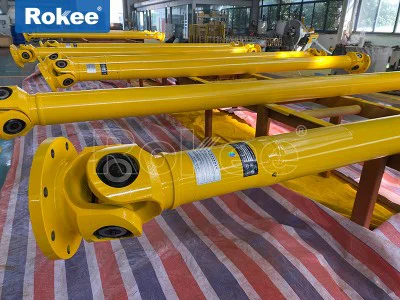
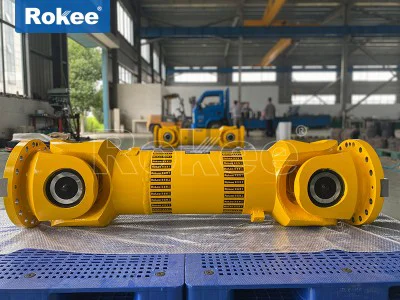
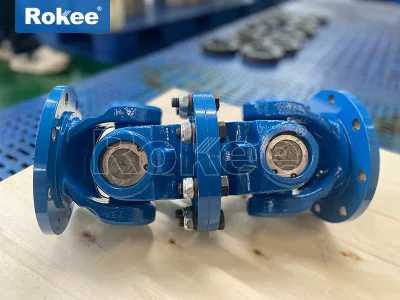
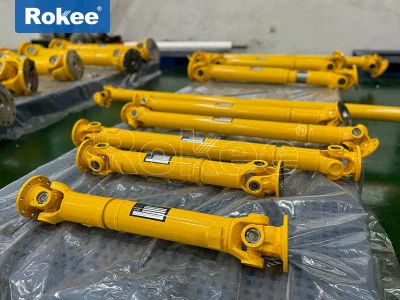
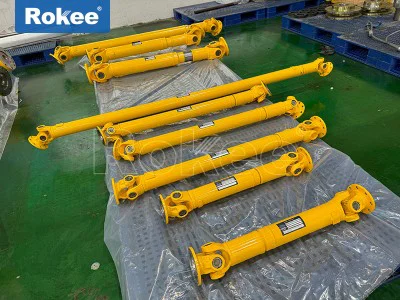
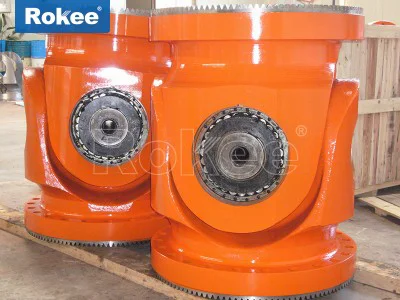
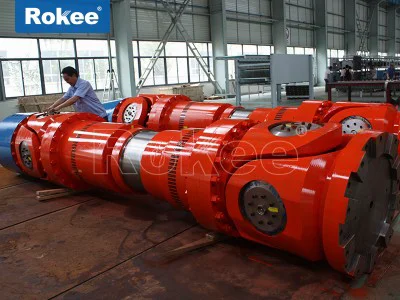
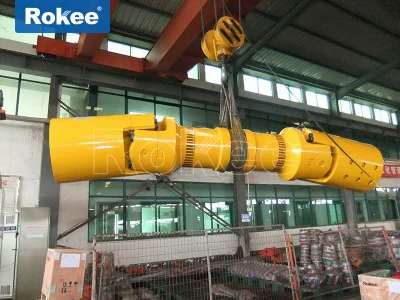
Cross Joint Couplings
The cross joint coupling consists of two fork joints, a cross shaft, and bearings, and power transmission is achieved through the articulated structure of the cross shaft.
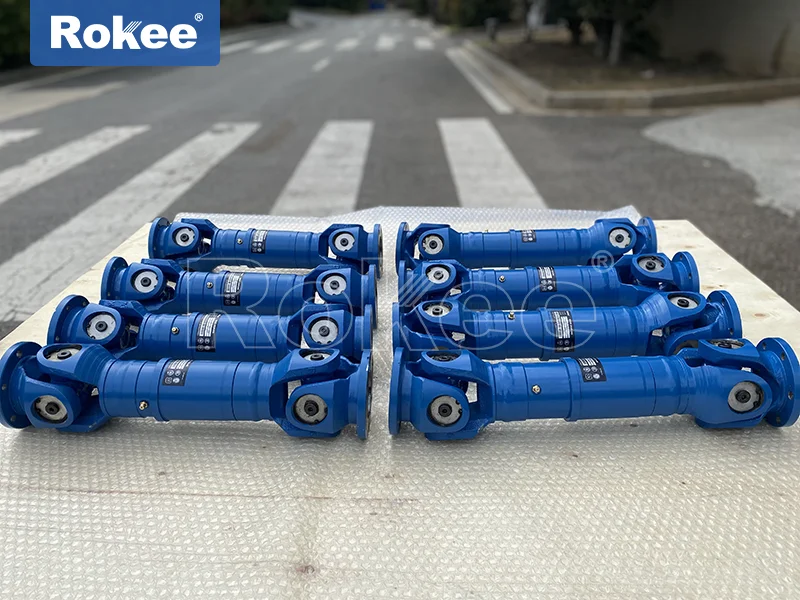
Core Features
Angle compensation capability: It allows for a deviation of 15 ° -25 ° in the angle between the two shafts (such as the connection between the gearbox and the drive axle in the automotive transmission system), adapting to the condition of misalignment of the shaft system.
Speed fluctuation adjustment: When using a single section, there is periodic fluctuation in the speed of the driven shaft. The double section series design can eliminate this phenomenon and ensure synchronous rotation (commonly seen in precision machinery).
performance advantage
High adaptability
Low requirements for installation accuracy, suitable for scenarios with high vibration and frequent shaft displacement (such as metallurgical rolling mills and construction machinery).Efficient transmission
The transmission efficiency reaches 96% -98%, with low energy loss, suitable for high torque transmission (such as transmitting thousands of Newton meters of torque in mining equipment).Compact design
Lightweight structure, with a minimum outer diameter of 20mm (such as the WSD type micro coupling), making it easy to install equipment with limited space.
Through reasonable selection and maintenance, cross joint couplings can significantly improve the reliability of transmission systems. Suggest consulting suppliers based on actual working conditions to obtain customized solutions.
Cross joint coupling, also widely referred to as universal joint coupling in mechanical engineering, stands as one of the most fundamental and indispensable power transmission components in modern industrial and mechanical systems. Engineered to bridge two rotating shafts that are not perfectly aligned, this component addresses the common challenge of shaft misalignment caused by installation errors, thermal expansion, mechanical deformation, or dynamic operational shifts, enabling seamless torque and rotational motion transfer even when angular, axial, or radial deviations exist between driving and driven shafts. Unlike rigid couplings that demand flawless shaft alignment and fail to accommodate any form of displacement, cross joint couplings introduce controlled flexibility into power transmission systems, striking a delicate balance between structural rigidity for torque delivery and adaptive flexibility for misalignment compensation. This unique combination of traits has cemented its status as a staple across countless industries, from heavy industrial machinery to precision automotive systems, agricultural equipment, and aerospace assemblies.
At its core, the standard cross joint coupling features a minimalist yet robust structural design built around a handful of key components, each engineered to withstand extreme mechanical stresses and ensure long-term operational stability. The primary constituents include two yoke assemblies (also called fork joints), a central cross-shaped shaft (commonly known as a spider), and four sets of precision needle roller bearings that facilitate smooth articulation between the yokes and the cross shaft. The yoke assemblies serve as the connection points between the coupling and the driving and driven shafts, typically secured via flanges, splines, or clamping mechanisms to prevent slippage under high torque loads. Crafted from high-strength alloy steels or carbon steels, these yokes are engineered to resist bending, torsional stress, and impact loads, with precision-machined bearing seats to house the needle roller assemblies securely. The central cross shaft, the heart of the coupling, features four orthogonal shaft necks that interlock with the corresponding bearing seats in the yokes, creating a hinged joint that permits angular movement in multiple planes. This cross-shaped design is what grants the coupling its signature flexibility, allowing it to maintain power transmission even when the two connected shafts form a significant angular offset. The needle roller bearings are equally vital, as they minimize friction between the rotating cross shaft and the stationary yoke components, reducing wear, heat generation, and energy loss during operation. Unlike standard ball bearings, needle rollers offer a larger contact surface area, enhancing load-bearing capacity and durability under heavy radial and thrust loads. Many high-performance cross joint couplings also incorporate sealed bearing assemblies to retain lubrication and block out contaminants like dust, moisture, and debris, extending service life and reducing maintenance requirements in harsh working conditions. This streamlined structural layout not only ensures reliable functionality but also simplifies manufacturing, installation, and upkeep, making the cross joint coupling a cost-effective and practical solution for diverse transmission needs.
The performance characteristics of cross joint couplings are defined by their ability to address key operational challenges in power transmission, with standout traits that set them apart from other flexible coupling types. Foremost among these is exceptional angular misalignment compensation, a defining feature that allows standard models to accommodate shaft angles ranging from 5 degrees to 45 degrees, depending on design specifications and size ratings. This flexibility eliminates the need for ultra-precise shaft alignment during installation, reducing assembly time and costs while preventing premature bearing failure in systems where shaft movement is inevitable. Beyond angular compensation, many cross joint coupling variants also offer limited axial displacement tolerance, typically ranging from ±10mm to ±50mm, enabled by integrated spline structures or telescopic shaft designs that absorb minor axial shifts caused by thermal expansion or mechanical vibration. In terms of torque transmission, these couplings boast high torsional rigidity and load-bearing capabilities, with heavy-duty models capable of transferring thousands of Newton-meters of torque without deformation or failure, making them suitable for heavy industrial applications. Transmission efficiency is another key performance metric, with most cross joint couplings achieving efficiency rates between 96% and 98%, minimizing energy waste and ensuring optimal power delivery from the driving source to the load. Additionally, these couplings exhibit strong resistance to shock loads and vibration, dampening mechanical disturbances to protect connected shafts, gears, and motors from damage. It is important to note, however, that single cross joint configurations exhibit a minor inherent limitation: periodic rotational speed fluctuations in the driven shaft when operating at significant angles, a result of the non-constant velocity transmission inherent to the basic Hooke’s joint design. This fluctuation is negligible in low-precision, heavy-duty applications but can be mitigated entirely through dual cross joint assemblies arranged in precise phasing, which deliver constant velocity transmission and smooth rotational output for high-precision systems.
Cross joint couplings are categorized into distinct types based on structural design, torque capacity, operational functionality, and application-specific requirements, with each classification tailored to excel in unique operational scenarios. The most common classification is based on structural configuration, which divides these couplings into single cross joint couplings, double cross joint couplings, and constant velocity cross joint couplings. Single cross joint couplings, the simplest and most widely used variant, feature a single cross shaft and two yokes, offering basic angular compensation and reliable torque transmission for general-purpose applications where minor speed fluctuations are acceptable. They are prized for their compact size, lightweight design, and cost efficiency, making them ideal for light to medium-duty systems with moderate misalignment. Double cross joint couplings, constructed with two interconnected single cross joints and an intermediate shaft, eliminate the speed fluctuation issue of single joints by balancing rotational dynamics, delivering smooth, constant velocity transmission even at larger shaft angles. This design also enhances overall misalignment compensation, allowing for greater angular, axial, and radial flexibility, and is preferred for high-precision machinery and systems requiring uniform rotational output. Constant velocity (CV) cross joint couplings represent a specialized, high-performance variant, engineered with refined internal geometries and bearing arrangements to ensure perfect synchronization between driving and driven shafts at all times, regardless of operating angle. These couplings are designed for extreme precision and high-speed applications, where even minimal speed variation or vibration would compromise performance. Another critical classification is based on load-bearing capacity, separating couplings into heavy-duty, medium-duty, light-duty, and miniature variants. Heavy-duty cross joint couplings feature reinforced yokes, oversized cross shafts, and heavy-gauge bearings, engineered to withstand extreme torque loads, shock impacts, and harsh industrial conditions, often used in large-scale machinery with demanding operational requirements. Medium-duty variants strike a balance between load capacity and flexibility, suitable for general industrial machinery and automotive systems. Light-duty and miniature couplings are compact, low-profile designs optimized for small-scale equipment, precision instruments, and light-load transmission systems, prioritizing space efficiency and smooth operation over maximum torque capacity. Additional classifications include telescopic cross joint couplings, which feature extendable intermediate shafts to accommodate variable axial distances between shafts, and sealed cross joint couplings, designed with fully enclosed bearing assemblies for use in corrosive, dusty, or wet environments where contamination is a major concern.
The versatility of cross joint couplings, driven by their diverse structural designs and performance profiles, translates to an extensive range of real-world applications across nearly every sector of mechanical engineering, with each type deployed to solve specific transmission challenges. In the automotive industry, cross joint couplings are integral components of drivetrain systems, connecting the transmission to the drive axle in passenger vehicles, commercial trucks, and off-road equipment. Single cross joint couplings are commonly used in propeller shafts for rear-wheel-drive and four-wheel-drive vehicles, accommodating the angular shifts between the chassis-mounted transmission and the suspension-mounted axle, while constant velocity cross joint couplings are employed in front-wheel-drive vehicles and independent suspension systems to deliver smooth, vibration-free power delivery to the wheels, even during steering and suspension movement. Agricultural machinery relies heavily on heavy-duty cross joint couplings, particularly in power take-off (PTO) systems for tractors, harvesters, and tillers. These couplings endure extreme shock loads, frequent angle changes, and exposure to dirt, mud, and debris, transferring high torque from the tractor engine to attached implements while adapting to the uneven terrain and dynamic movement of agricultural equipment. The robust construction of agricultural cross joint couplings ensures reliable performance in the harshest outdoor conditions, minimizing downtime and maintenance needs for farmers and agricultural operators.
Heavy industrial sectors, including metallurgy, mining, and construction, depend on heavy-duty cross joint couplings for large-scale machinery operation. In steel mills and metal processing facilities, these couplings are used in rolling mills, continuous casting machines, and conveyor systems, transmitting massive torque loads while compensating for shaft deformation caused by extreme heat and heavy operational stress. Mining equipment, such as crushers, conveyors, and drilling rigs, utilizes reinforced cross joint couplings to withstand the abrasive, high-shock environment of mining operations, ensuring uninterrupted power transmission even under continuous heavy use. Construction machinery, including excavators, cranes, bulldozers, and concrete mixers, relies on the angular flexibility and load-bearing capacity of cross joint couplings to connect hydraulic motors, engines, and drive systems, adapting to the constant movement and misalignment that occurs on construction sites. The ability to handle shock loads and extreme misalignment makes these couplings indispensable for mobile construction equipment, where rigid couplings would fail rapidly under dynamic operating conditions.
Precision engineering and manufacturing sectors utilize specialized cross joint couplings for high-precision machinery, including CNC machine tools, robotic assemblies, and automated production lines. Double cross joint and constant velocity couplings are preferred here, as their smooth, constant velocity transmission ensures accurate positioning, minimal vibration, and consistent rotational speed—critical factors for maintaining tight tolerances and high-quality output in precision manufacturing. These couplings are also used in aerospace and marine applications, where reliability and performance under extreme conditions are non-negotiable. In aerospace systems, lightweight, high-strength cross joint couplings are integrated into flight control mechanisms, rotor assemblies, and engine drive systems, offering precise power transmission with minimal weight and maximum durability. Marine propulsion systems use corrosion-resistant, sealed cross joint couplings to connect boat engines to propeller shafts, accommodating shaft misalignment caused by hull flexing and operating efficiently in saltwater environments without contamination or corrosion damage. Even in small-scale consumer and industrial equipment, such as pumps, compressors, fans, and conveyor belts, light-duty cross joint couplings provide reliable, low-maintenance power transmission, solving minor alignment issues and extending the service life of connected components.
Selecting the appropriate cross joint coupling for a specific application requires careful evaluation of multiple operational parameters to ensure optimal performance and longevity. Key considerations include the required torque capacity, operating speed range, degree of shaft misalignment (angular, axial, and radial), environmental conditions (temperature, moisture, contaminants), and available installation space. For heavy-load, high-shock environments, heavy-duty, sealed cross joint couplings are the optimal choice, while high-precision, high-speed systems demand constant velocity or double cross joint designs. Light-duty applications benefit from compact, economical single cross joint variants, while systems with variable shaft spacing require telescopic models. Proper installation and routine maintenance, including regular lubrication and bearing inspection, further enhance the performance and service life of cross joint couplings, ensuring they continue to deliver reliable power transmission throughout their operational lifespan. As manufacturing and materials science continue to advance, cross joint coupling designs are evolving to offer even greater load capacity, higher precision, and enhanced durability, expanding their potential applications and solidifying their role as a cornerstone of modern mechanical power transmission systems. From the largest industrial machinery to the most delicate precision instruments, the cross joint coupling remains a versatile, reliable, and essential component that enables the seamless operation of countless mechanical systems across the globe.