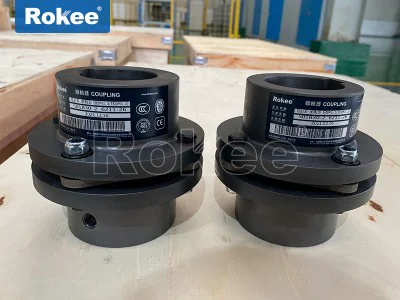
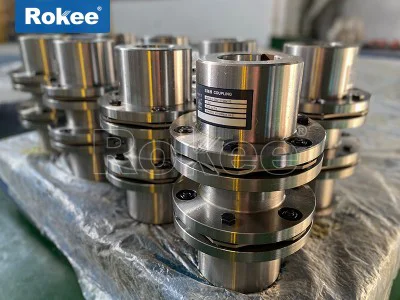
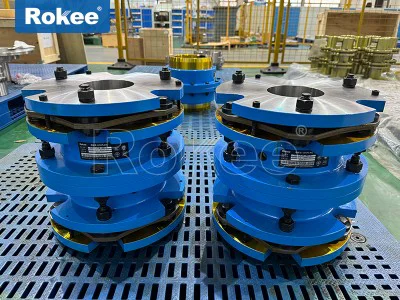
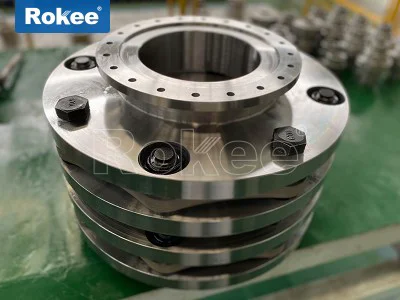
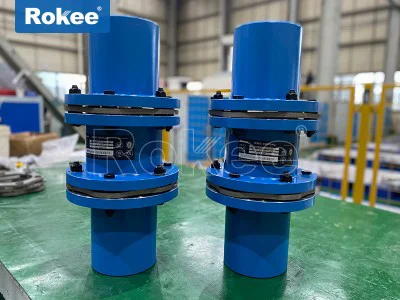
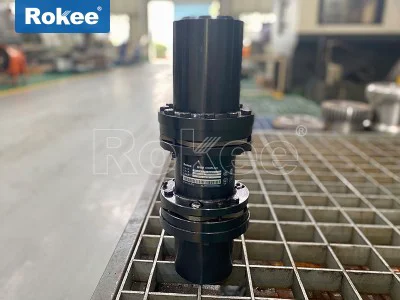
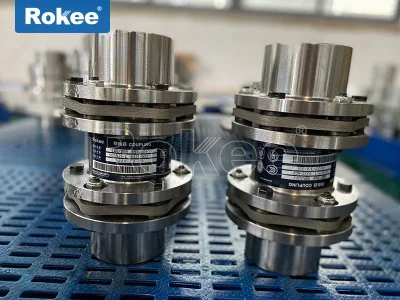
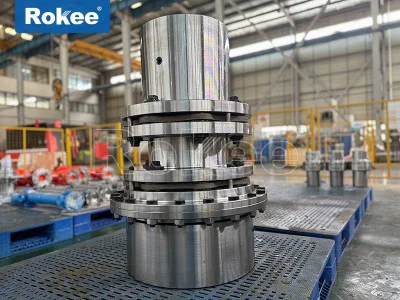
Metal Diaphragm Couplings
The metal diaphragm coupling is a flexible coupling with multiple layers of stainless steel thin plates (diaphragm groups) as the core component, which achieves power transmission by connecting the two halves of the coupling in a staggered manner with bolts.
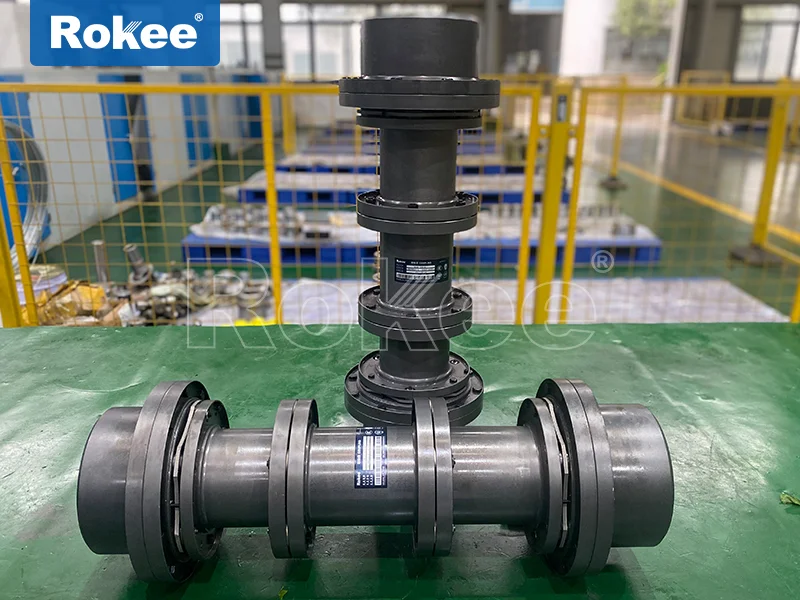
The core feature of metal diaphragm couplings is the use of the elastic deformation of the diaphragm to compensate for axial, radial, and angular displacements, making them suitable for high-precision transmission scenarios. According to the number of membrane groups, they can be divided into:
Single diaphragm coupling: simple structure, suitable for mild eccentric working conditions.
Double diaphragm coupling: With the collaborative deformation of two sets of diaphragms, it has stronger compensation ability and can handle complex deviations (such as angular deviation up to 1.5 degrees).
Performance advantage
High precision and high efficiency
The transmission efficiency is as high as 99.86%, with no rotational clearance, ensuring precise speed transmission, suitable for servo systems, precision machine tools and other scenarios.
The static torsional stiffness can reach 3400N · m/rad (such as double diaphragm type), and the dynamic response is excellent.Environmental adaptability
Wide temperature resistance range (-80 ℃ to+300 ℃), stable operation in corrosive media (acid, alkali, oil).
No lubrication required, maintenance free design reduces long-term usage costs.Mechanical properties
The compensation capability is significantly better than that of gear couplings, with smaller radial displacement reaction force and a 100% increase in angular compensation capability.
The peak torque can reach twice the rated value and has overload protection function.
Membrane stress analysis
Thin film stress: generated by torque transmission, calculated as single piece torque (T1=T/m) (total torque/number of membrane groups).
Centrifugal stress: Inertial force acts during high-speed rotation, and the upper limit of the rotational speed needs to be controlled (such as the JZM type with a maximum of 10700 RPM).
Installation deviation stress: Axial/angular errors lead to periodic bending deformation, which is the main factor affecting fatigue life.
Materials and processes
The membrane is mostly made of 304 or 316L stainless steel, which is laser cut or stamped into shape, and the stacking thickness is usually 0.2-0.5mm.
The pre tightening force of the bolt needs to be precisely controlled, and the clearance requirements are strict (such as a clearance of 0.2-0.3mm between the flange hole and the bolt).
Selection criteria
Select the model based on torque (25-100000 N · m), speed (up to 15300 RPM), and shaft diameter (10-290mm).
Prioritize the intermediate shaft type (such as JMIJ series) to enhance deviation compensation capability.
Installation specifications
The axial deviation should be controlled within 1/3 of the allowable value (radial ≤ 0.05mm, angular ≤ 0.5 °).
The installation of bolts should be tightened in stages according to diagonal order, and a torque wrench should be used to ensure even torque.
Maintenance suggestions
Regularly check for membrane cracks or loose bolts, and it is recommended to perform dynamic balance testing every 5000 hours.
Under extreme working conditions, molybdenum disulfide coating can be applied to the membrane to extend its lifespan.
Metal diaphragm couplings with their irreplaceable performance advantages, are gradually replacing traditional gear couplings and becoming the preferred solution for modern industrial transmission systems.
In the field of mechanical power transmission, the metal diaphragm coupling stands out as a highly versatile and reliable component that bridges the gap between driving and driven shafts, addressing the inherent challenges of misalignment, vibration, and torque transmission in diverse industrial systems. Unlike rigid couplings that offer no flexibility or elastomeric couplings that suffer from limited durability and temperature resistance, metal diaphragm couplings rely on the elastic deformation of precision-engineered metal diaphragms to achieve flexible power delivery, combining the rigidity of metal components with the adaptability of flexible transmission structures. This unique design has made them a staple in high-precision, high-speed, and heavy-duty mechanical applications, where consistent performance, long service life, and minimal maintenance are non-negotiable requirements.
At its core, the metal diaphragm coupling is constructed with a set of key components that work in harmony to transmit torque while accommodating shaft misalignments, with no relative sliding friction between parts, a feature that sets it apart from many other coupling types. The primary components include two hub halves that attach to the driving and driven shafts respectively, a series of thin, flexible metal diaphragms (often referred to as diaphragm packs), and high-strength fasteners that secure the diaphragms between the hubs. In some extended designs, an intermediate spacer or shaft may be integrated between the two diaphragm sets to increase the distance between the connected shafts, catering to applications with larger shaft separations. The metal diaphragms are the heart of the coupling, typically manufactured from high-grade alloy steels or stainless steels that boast exceptional fatigue resistance, tensile strength, and elastic recovery properties. These diaphragms are precision-machined into thin, circular or contoured profiles, with bolt holes strategically positioned to distribute stress evenly across the surface during operation. The hubs are usually made from durable carbon steel or alloy steel, machined to tight tolerances to ensure a secure and concentric fit with the shaft ends, whether through keyway connections, clamping fixtures, or tapered fits. Unlike gear couplings or chain couplings that rely on meshing parts, the metal diaphragm coupling operates through pure elastic deformation of the diaphragm pack; when torque is applied, the diaphragms flex slightly to accommodate angular, parallel, and axial misalignments between the shafts, without creating excessive wear or generating heat from friction. This frictionless operation not only preserves the integrity of the coupling components but also maintains efficient power transmission with minimal energy loss, making the structure both robust and efficient.
The performance characteristics of metal diaphragm couplings are directly derived from their structural design, making them suitable for demanding operating conditions that would compromise the functionality of other coupling variants. One of the most prominent performance advantages is their exceptional misalignment compensation capability, which allows them to handle three primary types of shaft misalignment: angular misalignment, parallel misalignment, and axial misalignment. Angular misalignment occurs when the two shafts intersect at a small angle, while parallel misalignment refers to lateral offset between the shaft axes, and axial misalignment involves endwise movement of the shafts along their axis. The flexible metal diaphragms can bend and stretch to absorb these misalignments without transmitting excessive forces or bending moments to the connected equipment, protecting bearings, gears, and other critical components from premature failure. Another key performance trait is their high torque transmission capacity relative to their compact size and lightweight construction. The metal diaphragm design maximizes torque density, enabling the coupling to handle substantial torque loads even in space-constrained installations, a critical benefit in modern machinery where miniaturization and efficiency are prioritized. Additionally, metal diaphragm couplings exhibit excellent high-speed performance, with the ability to operate reliably at extremely high rotational speeds without dynamic imbalance or vibration issues. The balanced design of the diaphragms and hubs minimizes rotational inertia, reducing centrifugal forces and ensuring smooth operation even at elevated speeds, a feature that is indispensable in turbomachinery and other high-speed drive systems.
Durability and low maintenance are also hallmark performance features of metal diaphragm couplings. Constructed from corrosion-resistant and wear-resistant metals, these couplings can withstand harsh operating environments, including high temperatures, chemical exposure, and dusty or humid conditions, without degradation. Unlike elastomeric couplings that require periodic replacement of rubber or plastic components due to hardening, cracking, or wear, metal diaphragm couplings have no consumable parts, resulting in near-zero maintenance requirements over their service life. This longevity translates to reduced downtime and lower operational costs for industrial facilities, making them a cost-effective long-term solution. Furthermore, metal diaphragm couplings offer consistent torsional stiffness, which is crucial for precision motion control applications. The predictable elastic behavior of the metal diaphragms ensures that torque is transmitted smoothly and accurately, with minimal backlash or torsional windup, supporting precise positioning and synchronization in automated machinery, robotics, and precision manufacturing equipment. They also exhibit good vibration damping properties, absorbing minor shocks and vibrations generated during operation, which helps to reduce noise levels and enhance the overall stability of the drive system. Collectively, these performance attributes make metal diaphragm couplings a superior choice over alternative coupling types in applications that demand reliability, precision, and resilience.
Metal diaphragm couplings are classified into several distinct types based on structural variations, misalignment compensation capabilities, and application-specific design features, each tailored to meet unique operational requirements. The most common classification is based on the number of diaphragm groups and the presence of an intermediate component, which divides them into single diaphragm couplings, double diaphragm couplings, and multi-diaphragm couplings with intermediate shafts. Single diaphragm couplings feature a single set of diaphragms connecting the two hubs, offering a compact and simple design ideal for applications with minimal misalignment requirements and short shaft distances. They are lightweight, easy to install, and cost-effective, making them suitable for small-scale machinery, light-duty pumps, and precision instruments where space is limited and misalignment is negligible. Double diaphragm couplings, by contrast, incorporate two separate diaphragm packs with a short intermediate spacer between them, significantly enhancing their ability to compensate for parallel and angular misalignment. This dual-diaphragm design distributes flexure across two sets of diaphragms, reducing stress concentration and extending service life, making them the most widely used type in general industrial applications, from fans and blowers to medium-duty pumps and conveyors.
Multi-diaphragm couplings with intermediate shafts, often referred to as long-span diaphragm couplings, are designed for applications where the distance between the driving and driven shafts is substantial. The extended intermediate shaft, paired with two diaphragm assemblies at either end, allows for large axial separations while maintaining excellent misalignment compensation and torque transmission. These couplings are engineered to minimize bending stresses on the intermediate shaft and diaphragms, ensuring stable operation even with significant shaft spacing, making them ideal for large industrial equipment such as centrifugal compressors, steam turbines, and long-distance conveyor systems. Another classification criterion is the mounting and connection style, which includes clamp-type couplings, keyed couplings, and tapered bore couplings. Clamp-type metal diaphragm couplings use a compression hub design to grip the shaft tightly without the need for keyways, eliminating backlash and ensuring concentricity, making them perfect for high-precision applications like servo motors and CNC machinery. Keyed couplings feature traditional keyway connections for secure torque transmission in heavy-duty applications with high torque loads, while tapered bore couplings use a tapered interface to create a tight, interference fit between the hub and shaft, suitable for high-speed and high-vibration environments where a secure shaft connection is critical. Additionally, metal diaphragm couplings can be categorized by diaphragm design, including single-piece diaphragms and laminated diaphragm packs; laminated diaphragms, composed of multiple thin metal sheets bonded together, offer greater flexibility and fatigue resistance than single-piece diaphragms, making them preferred for heavy-duty and high-cycle applications.
The versatility of metal diaphragm couplings, stemming from their robust structure and exceptional performance, has led to their adoption across a vast array of industrial sectors, each leveraging their unique benefits to optimize machinery performance and reliability. In the power generation industry, metal diaphragm couplings are extensively used in turbine systems, including steam turbines, gas turbines, and hydro turbines, where high speeds, high temperatures, and precise torque transmission are essential. Their ability to operate reliably at extreme speeds and temperatures, coupled with zero maintenance requirements, makes them indispensable for connecting turbine shafts to generators, compressors, and other auxiliary equipment, ensuring uninterrupted power production. In the oil and gas sector, these couplings are employed in upstream, midstream, and downstream operations, from drilling rigs and pump jacks to refinery pumps, compressors, and conveyor systems. The corrosion-resistant metal construction withstands harsh chemical environments, while their misalignment compensation capability protects equipment from the vibrations and shaft offsets common in oil and gas processing, enhancing operational safety and efficiency.
The manufacturing and machining industry relies heavily on metal diaphragm couplings for high-precision equipment, including CNC machine tools, robotic arms, grinding machines, and milling machines. The zero-backlash design, high torsional stiffness, and precise motion transmission ensure accurate positioning and smooth operation, critical for producing high-tolerance machined components and enabling automated manufacturing processes. In the aerospace and defense sector, where weight, reliability, and performance are paramount, metal diaphragm couplings are used in aircraft propulsion systems, ground support equipment, and defense machinery, offering lightweight construction, high torque density, and exceptional durability in demanding operational conditions. The pumping and ventilation industry also benefits greatly from metal diaphragm couplings, which are widely integrated into centrifugal pumps, water treatment pumps, industrial fans, and blowers. Their ability to handle shaft misalignment common in pump and fan installations, combined with low vibration and long service life, reduces maintenance frequency and extends the operational life of the entire fluid handling system.
Beyond these core sectors, metal diaphragm couplings find applications in the marine industry, powering shipboard machinery such as propeller drives, pump systems, and ventilation equipment, where they resist saltwater corrosion and withstand the dynamic conditions of marine environments. In the food and beverage processing industry, they are used in sanitary processing equipment, mixing systems, and packaging machinery, thanks to their smooth, easy-to-clean design and resistance to washdown environments. The pharmaceutical industry also utilizes these couplings in precision manufacturing and packaging equipment, where hygienic operation, precision, and reliability are critical. Even in the automotive and heavy machinery sectors, metal diaphragm couplings are employed in engine test benches, transmission systems, and construction equipment, delivering robust torque transmission and durability in high-load, high-vibration settings.
As industrial technology continues to advance toward higher precision, higher efficiency, and greater reliability, the demand for metal diaphragm couplings is expected to grow steadily, driven by their ability to meet the evolving needs of modern machinery. Their unique combination of flexible misalignment compensation, high torque capacity, high-speed operation, low maintenance, and long service life positions them as a critical component in nearly every branch of mechanical engineering. Unlike other coupling solutions that compromise on performance or durability, metal diaphragm couplings strike a perfect balance between rigidity and flexibility, adapting to the complexities of real-world mechanical systems while maintaining consistent, efficient operation. Whether in small-scale precision instruments or large-scale industrial power plants, these couplings play a vital role in ensuring seamless power transmission, protecting valuable machinery, and optimizing overall operational efficiency. The ongoing refinement of diaphragm materials, manufacturing processes, and design engineering will only further enhance their performance capabilities, solidifying their status as a cornerstone component in the global mechanical transmission industry for years to come.