Construction Of Universal Shaft Coupling
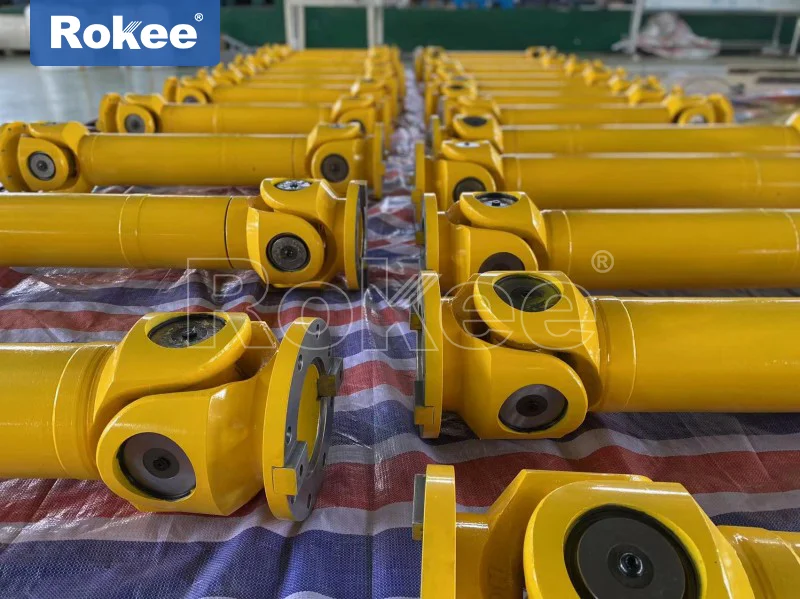
As a key component in mechanical transmission systems, universal shaft coupling plays an irreplaceable role in various industrial equipment. Its unique structural design enables it to compensate for angular deviation and axial displacement between two axes, achieving reliable transmission of power and motion.
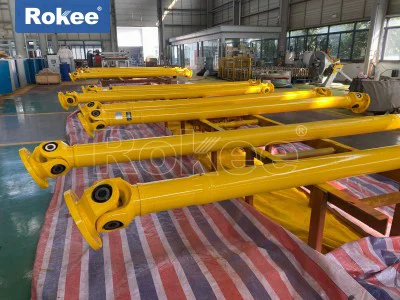
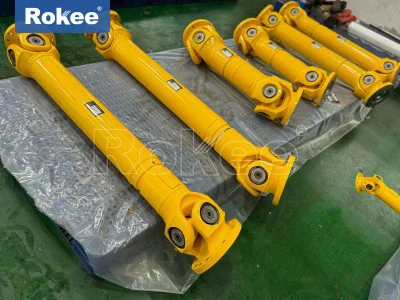
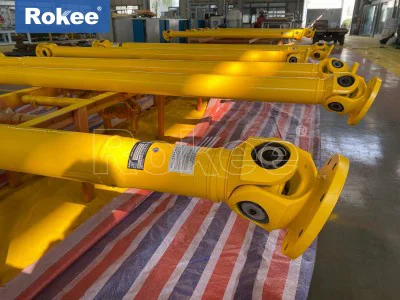
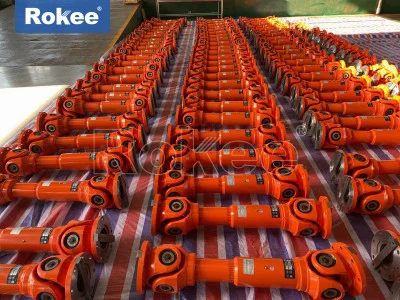
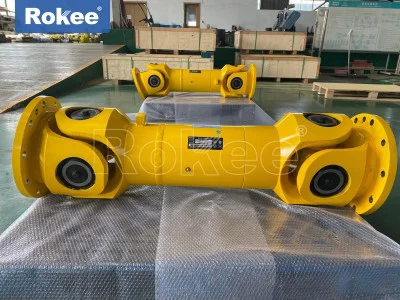
The core function of a cardan shaft coupling is to connect two shafts on different axes, allowing for effective power transmission even with a certain degree of angular deviation between the two shafts. Its basic structure usually consists of several key components:
Cross shaft: As the core component of the universal joint, the cross shaft is usually made of high-strength alloy steel and undergoes precision machining and heat treatment to improve its wear resistance and load-bearing capacity. The four necks of the cross shaft are respectively matched with the bearings on the two fork heads to form a rotatable connection.
Bearing components: Modern universal couplings often use needle roller bearings or sliding bearings design. Needle roller bearings are widely used due to their high load capacity and compact structure. The outer ring of the bearing is usually pressed into the bearing hole of the fork, and the inner ring is tightly matched with the cross shaft journal. Some heavy-duty applications may use radial rolling thrust bearings to transmit large torque in small space diameters.
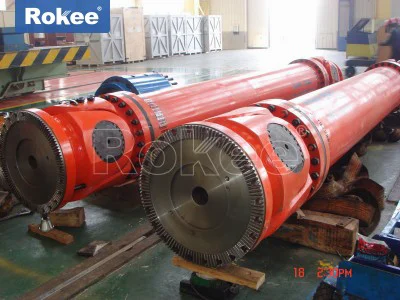
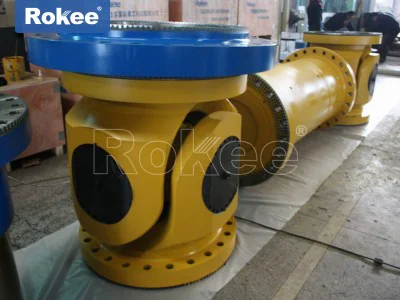
Flange fork: Fork components are usually divided into two forms: welded fork and flange fork. SWC type adopts an integral fork head design, which is more sturdy in structure; The SWP type adopts a split fork layout for easy installation and maintenance. The fork head is connected to the transmission shaft through a flange or welding method, and its design directly affects the torque transmission capacity of the coupling.
Sealing and lubrication system: To prevent lubricant leakage and contamination from entering, the universal joint coupling is equipped with multiple sealing devices, including rubber oil seals, labyrinth seals, etc. Lubrication methods can be divided into regular oil injection and pre lubrication sealing. Under high temperature and heavy load conditions, oil injection is usually required once a day, while under normal conditions, oil injection can be done once a week.
Safety protection cover: Some universal couplings will be equipped with protective covers, which not only prevent foreign objects from entering the moving parts, but also prevent lubricating grease splashing and polluting the environment, while improving operational safety.
This structure enables the universal shaft coupling to adapt to axis angles of 5 ° -45 °, and some special designs can even achieve compensation for larger angles. Compared with ordinary couplings, universal couplings can maintain high transmission efficiency even in the presence of axis deviation, and have a compact structure and high load-bearing capacity, making them the preferred transmission components in fields such as engineering machinery and metallurgical equipment.
A universal shaft coupling stands as a cornerstone component in mechanical power transmission systems, engineered to bridge two rotating shafts that are not collinearly aligned, enabling seamless torque transfer and rotational motion across angular, parallel, or axial misalignments that are unavoidable in real-world machinery operation. Unlike rigid couplings that demand perfect shaft alignment and fail to accommodate any positional deviation, universal shaft couplings are purpose-built to flex and adapt to dynamic shaft movements, making them indispensable across a vast spectrum of industrial, automotive, aerospace, and heavy machinery applications. The construction of these couplings is a meticulous blend of mechanical design, material science, precision manufacturing, and performance engineering, with every structural element and fabrication step tailored to balance strength, flexibility, durability, and operational efficiency under diverse load conditions and environmental stresses. At its core, the construction process revolves around translating the fundamental kinematic principles of universal joint motion into a tangible, robust assembly that can withstand cyclic loads, frictional wear, and operational fatigue while maintaining consistent power transmission capabilities.
The foundational design of a standard universal shaft coupling, often referred to as a Cardan or Hooke’s coupling, centers on a few core interlocking components that define its functional integrity: two yoke assemblies (also called fork heads), a central cross-shaped spider (or cross shaft), precision bearing sets, locking hardware, and sealing mechanisms. Each component is engineered with tight dimensional tolerances to ensure proper fit, smooth articulation, and load distribution, with no room for manufacturing discrepancies that could compromise joint performance or accelerate wear. The yoke assemblies serve as the primary connection points between the coupling and the driving and driven shafts; one yoke attaches to the input shaft delivering rotational power, while the other links to the output shaft receiving that power. These yokes are typically forged or machined from high-strength metallic alloys to resist torsional deformation, bending stress, and shock loads, with their inner contours precision-machined to accommodate the bearing journals of the central spider. The angular orientation of the yokes is critical—they are positioned perpendicularly to one another relative to the spider’s axis, creating a articulated joint that can pivot freely to compensate for shaft misalignment without binding or losing torque transmission efficiency.
The central cross spider is the heart of the universal shaft coupling, acting as the intermediary that transfers torque between the two misaligned yokes and shafts. Crafted from hardened alloy steel, the spider features four orthogonal journals that extend outward, each designed to seat within a bearing assembly housed in the corresponding yoke arm. The geometry of the spider is precision-engineered to ensure uniform load distribution across all bearing surfaces, preventing localized stress concentrations that could lead to premature failure. The bearing assemblies, most commonly needle roller bearings or tapered roller bearings, are integral to the coupling’s smooth operation; they reduce friction between the rotating spider journals and the stationary yoke housings, enabling low-friction articulation even under heavy radial and torsional loads. Needle roller bearings are preferred in many standard designs for their high load-carrying capacity in compact spaces, minimizing the overall profile of the coupling while maximizing wear resistance and service life. Each bearing is fitted with a precision-machined outer race that locks into the yoke and an inner race that secures to the spider journal, creating a friction-reducing interface that supports both rotational motion and angular deflection.
Material selection is a pivotal phase in the construction of universal shaft couplings, directly dictating the component’s mechanical properties, wear resistance, fatigue life, and suitability for specific operating environments. For heavy-duty, high-torque applications, forged alloy steels such as 40Cr, 42CrMo, or similar medium-carbon alloy steels are the material of choice for yokes and spiders; these materials undergo specialized heat treatment processes—including quenching and tempering—to enhance tensile strength, hardness, and toughness, ensuring they can withstand extreme torsional loads, shock impacts, and cyclic stress without cracking or deforming. For applications requiring corrosion resistance, such as marine, chemical processing, or outdoor heavy machinery, stainless steel alloys or nickel-plated carbon steel components are utilized to prevent rust and oxidative degradation, preserving structural integrity in humid, corrosive, or high-moisture environments. Lightweight applications, such as automotive drivetrains or precision industrial machinery, may employ high-strength aluminum alloys or advanced composite materials for non-load-bearing components to reduce rotational inertia and minimize energy loss during operation. Regardless of the base material, all critical load-bearing surfaces undergo precision finishing processes, including grinding and honing, to achieve ultra-smooth surfaces that reduce friction, improve bearing seating, and prevent premature wear of mating components.
The manufacturing and assembly process of a universal shaft coupling is a highly controlled sequence of operations that prioritizes precision, consistency, and structural integrity. Forged yoke blanks are first machined using CNC lathes and milling machines to achieve exact dimensional specifications, with key features such as bearing bores, shaft mounting bores, and bolt holes machined to tight tolerances within a few micrometers. The central cross spider is similarly machined from a solid alloy steel forging, with its four journals ground to precise diameters to ensure a press-fit or slip-fit with the bearing inner races. Bearing assemblies are pre-lubricated during manufacturing with high-performance grease or oil tailored to the coupling’s operating temperature and load range, providing long-term lubrication to minimize friction and wear. Assembly begins with pressing the bearing assemblies into the machined bores of each yoke, followed by inserting the cross spider journals into the bearings to link the two yokes into a single articulated unit. Locking mechanisms, such as snap rings, lock nuts, or retaining plates, are then installed to secure the bearings and spider in place, preventing axial displacement during operation and maintaining proper alignment of moving components.
Sealing is a critical yet often overlooked aspect of universal shaft coupling construction, designed to protect the internal bearing and lubrication systems from contamination by dust, dirt, moisture, debris, or abrasive particles present in industrial operating environments. Effective sealing preserves the integrity of the lubricant, prevents premature bearing wear, and extends the overall service life of the coupling. Common sealing solutions include lip seals, labyrinth seals, or rubber bellows seals, each selected based on the coupling’s application and operating conditions. Lip seals are ideal for general industrial use, providing a reliable barrier against contaminants while accommodating minor shaft movement; labyrinth seals are preferred for heavy-duty, high-contamination environments, offering a non-contact sealing design that resists wear and performs reliably under extreme conditions. Properly installed seals ensure that the internal lubrication remains uncontaminated and retained within the joint, eliminating the need for frequent re-lubrication and reducing maintenance requirements over the coupling’s lifespan.
Beyond the basic single joint design, advanced universal shaft coupling constructions address inherent limitations of standard single Cardan joints, most notably non-uniform rotational velocity output that can cause vibration, noise, and accelerated wear in precision applications. A double universal shaft coupling, constructed with two single joint assemblies linked by an intermediate shaft, is engineered to eliminate velocity fluctuations by phasing the two joints 90 degrees relative to one another. This phased arrangement cancels out the angular velocity variations produced by each individual joint, delivering constant-velocity power transmission even when shafts are significantly misaligned. The construction of double couplings incorporates all the core components of single joints, with the addition of a precision-machined intermediate shaft that maintains proper joint phasing and load transfer between the two articulating joints. This design is widely adopted in high-speed machinery, automotive drivetrains, and precision industrial equipment where smooth, vibration-free operation is critical.
Performance validation and quality control are integral steps in the construction process, ensuring every universal shaft coupling meets strict mechanical performance standards before deployment. Each completed coupling undergoes a series of non-destructive and operational tests to verify structural integrity, load capacity, articulation range, and frictional performance. Torque testing applies rated and overload torsional loads to confirm the coupling can withstand design stresses without failure or permanent deformation; articulation testing verifies full range of motion across specified misalignment angles to ensure smooth pivoting without binding; balance testing ensures rotational symmetry to minimize vibration at high operating speeds; and leak testing validates the effectiveness of sealing systems to prevent lubricant loss and contamination ingress. Any component failing these tests is rejected or reworked, ensuring only couplings that meet rigorous quality benchmarks enter service.
The adaptability of universal shaft coupling construction is evident in its ability to be customized for specialized applications, with design modifications tailored to unique load requirements, misalignment ranges, speed parameters, and environmental conditions. For heavy industrial machinery such as rolling mills, mining equipment, or construction machinery, couplings are constructed with reinforced yokes, oversized spiders, and heavy-duty bearings to handle extreme high-torque, low-speed operation and severe shock loads. For high-speed precision machinery such as machine tools, textile equipment, or aerospace actuators, couplings feature compact, lightweight designs, precision-balanced components, and constant-velocity joint configurations to maintain accuracy and minimize energy loss at high rotational speeds. Flexible coupling variations may incorporate elastomeric elements between the yoke and spider to dampen vibration, absorb shock loads, and reduce noise transmission, enhancing the overall performance of the power transmission system and protecting connected equipment from damage.
Proper integration and installation are final critical steps that complement the robust construction of universal shaft couplings, ensuring optimal performance and longevity. The coupling must be mounted to the driving and driven shafts with precise alignment, even though it is designed to compensate for misalignment; excessive or improper initial alignment can place unnecessary stress on the joint, leading to premature wear, increased friction, and reduced service life. Shaft mounting methods vary by design, with keyways, set screws, clamping hubs, or tapered bushings used to secure the coupling yokes to the shafts, ensuring a rigid, slip-free connection that transfers torque efficiently. Once installed, periodic maintenance—including lubrication checks, seal inspections, and wear monitoring—preserves the coupling’s performance, but the inherent durability of its construction minimizes routine upkeep, making it a cost-effective and reliable solution for long-term power transmission applications.
In summary, the construction of a universal shaft coupling is a sophisticated fusion of design ingenuity, material science, precision manufacturing, and quality assurance, each element working in tandem to create a component that excels in its core function: transmitting power across misaligned shafts reliably and efficiently. From the selection of high-strength materials and precision machining of critical components to the integration of friction-reducing bearings, effective sealing, and performance validation, every step in the construction process is focused on enhancing durability, operational efficiency, and adaptability. As a vital link in mechanical power transmission systems, the universal shaft coupling’s robust construction ensures it can withstand the rigors of diverse operating environments, from heavy industrial settings to high-precision machinery, making it an irreplaceable component in modern mechanical engineering. Its ability to balance flexibility and strength, accommodate misalignment, and deliver consistent torque transmission solidifies its role as a fundamental building block in nearly every industry that relies on rotational power transfer.