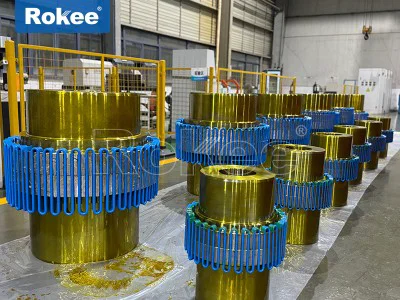
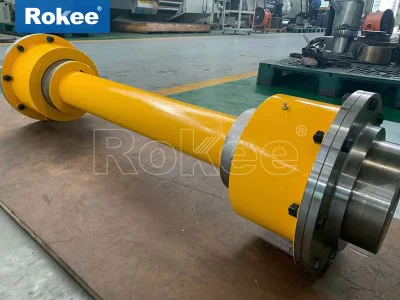
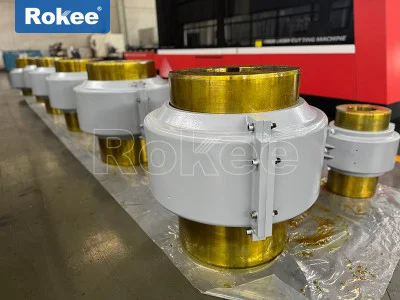
Steelflex Grid Couplings
Steelflex grid coupling is a mechanical transmission device that uses
special spiral springs as elastic elements. It connects shafts through
the elastic deformation of metal springs and compensates for the
relative displacement between the two shafts. This type of coupling
occupies an important position in the modern industrial transmission
field due to its unique structural design and excellent performance
characteristics.
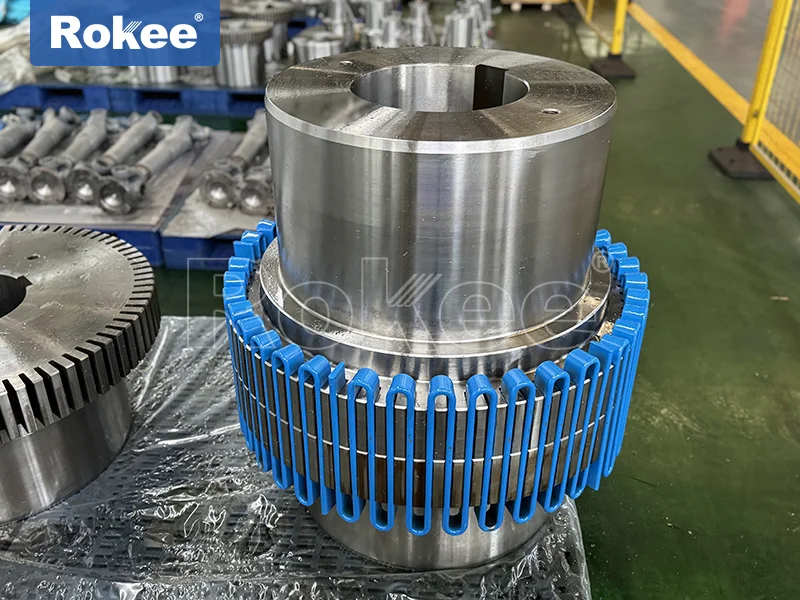
Core working principle: The steelflex grid coupling is mainly composed of two half couplings and a serpentine spring placed in them. When power is input from one end, torque is transmitted to the other end through the elasticity of the serpentine spring. Springs produce controllable elastic deformation during the transmission of torque, which can not only absorb vibration and impact, but also automatically compensate for axial, radial, and angular deviations.
Structural characteristics of steelflex grid coupling
Serpentine Spring Component: A high elasticity spiral spring made of high-quality alloy steel, which has undergone special heat treatment and has extremely high fatigue life. Spring cross-sections are typically designed as rectangles or trapezoids to optimize stress distribution.
Coupling housing: a precision machined metal shell with tooth grooves on the inner wall that match the shape of the spring, ensuring that the spring can evenly distribute the load when subjected to force. Modern advanced models often use aviation aluminum alloy materials to reduce weight.
Lubrication system: Most steelflex grid couplings are equipped with long-lasting grease or oil grooves, and some high-performance products use self-lubricating composite materials, significantly reducing maintenance requirements.
Protective device: dustproof sealing ring and protective cover design to prevent external pollutants from entering the work area and extend the service life.
The outstanding advantages of the steelflex grid coupling
Excellent vibration damping performance: The elastic deformation of the spring can absorb up to 85% of the vibration energy, significantly reducing the amplitude of vibration transmitted to the driven shaft.
Super strong deviation compensation capability: The unique three-dimensional elastic structure can simultaneously compensate for axial, radial, and angular deviations.
Extremely low maintenance cost: The design life of high-quality products usually exceeds 50000 working hours, and models with long-term lubrication systems can achieve maintenance free operation for more than 5 years.
Overload protection function: When the torque exceeds the rated value, the spring will undergo greater deformation without immediately breaking, providing buffering time for the system.
Compact and efficient design: Compared to gear couplings with the same torque capacity, the serpentine spring type can reduce volume by 25-40% and weight by more than 30%, making it particularly suitable for applications with limited space.
Typical application areas and selection suggestions
In the field of heavy industry:
Large compressor units (such as natural gas pipeline compressors)
Rolling mill transmission system
Mining crushing equipment
Suggest choosing the heavy-duty series, paying attention to torque margin and dust resistance performanceEnergy industry:
Generator set (gas turbine, steam turbine)
Connection of wind power growth box
Water pump unit
Recommend using high-precision balanced version, with strict matching of speed requiredShip and Ocean Engineering:
Main propulsion system
Deck mechanical transmission
Power positioning system
Corrosion resistant models must be selected, taking into account their adaptability to seawater environmentsSpecial industrial applications:
Key equipment of nuclear power plant
Aerospace Test Stand
high-precision machine tool
Customized design is required, with a focus on material purity and temperature stability
Key technical points for installation and debugging
Alignment calibration:
Use a laser centering device to ensure axial deviation<0.05mm
Control the angular deviation within 0.02 °
Reserve appropriate axial clearance (usually 0.5-1.5mm)Pre tightening force adjustment:
Set according to the torque displacement curve provided by the manufacturer
The typical preload is 3-5% of the free length
Use a torque wrench to tighten evenly in stagesOperation monitoring:
Check temperature changes every 8 hours during the initial operation phase
The vibration value should be ≤ 2.5mm/s (RMS)
Regularly check the lubrication status (every 2000 operating hours)
The steelflex grid coupling is evolving towards a more intelligent, efficient, and long-lasting direction, continuing to consolidate its preferred position in key transmission fields. Correctly selecting and using this type of coupling can significantly improve equipment reliability and reduce full lifecycle costs, making it an ideal choice for optimizing modern industrial transmission systems.
In the intricate landscape of mechanical power transmission, grid couplings stand out as versatile, durable components that bridge rotating shafts, transfer torque efficiently, and mitigate operational stresses across countless industrial setups. Unlike rigid coupling mechanisms that offer no flexibility, grid couplings are engineered with a unique structural design that balances torsional strength and adaptive flexibility, making them indispensable for machinery operating under dynamic loads, misaligned shafts, and fluctuating operational conditions.
At its core, the structural design of a grid coupling is defined by simplicity and functional efficiency, consisting of two robust hubs, a flexible metallic grid element, and a protective outer cover that safeguards internal components from contaminants and retains lubrication. The hubs, typically forged from high-strength alloy steel or ductile iron, are precision-machined with curved, evenly spaced grooves on their inner faces, tailored to cradle the flexible grid securely. These grooves are not merely structural; their curved profile facilitates smooth contact with the grid, enabling controlled flexing during operation and preventing concentrated stress points that could lead to premature wear or failure. The flexible grid, the heart of the coupling, is crafted from hardened spring steel or high-tensile alloy, formed into a serpentine, mesh-like pattern that delivers exceptional elasticity while maintaining superior torque transmission capabilities. This grid is inserted into the matching grooves of both hubs, creating a continuous connection between the driving and driven shafts without rigid metal-to-metal bonding. The outer cover, often constructed from cast iron or lightweight aluminum, encloses the hub-grid assembly, sealing in lubricant to reduce friction between the grid and hub grooves, shielding internal parts from dust, moisture, debris, and other environmental hazards, and containing any potential wear particles to prevent damage to surrounding machinery components. Unlike more complex coupling designs, the grid coupling’s modular structure allows for straightforward assembly, disassembly, and maintenance; the grid can be replaced independently without removing the hubs from the shafts, minimizing downtime and reducing long-term operational costs for industrial facilities.
The performance characteristics of grid couplings are a direct product of their specialized structural design, setting them apart from other flexible coupling types and making them suitable for demanding operational environments. One of the most prominent performance traits is their exceptional ability to accommodate shaft misalignment, a common issue in industrial machinery caused by manufacturing tolerances, installation errors, thermal expansion, or mechanical vibration during operation. Grid couplings can effectively compensate for angular misalignment, parallel misalignment, and axial shaft movement simultaneously, absorbing minor to moderate deviations without transferring excessive stress to connected equipment. This misalignment tolerance eliminates the need for ultra-precise shaft alignment during installation, simplifying setup procedures and reducing the risk of premature bearing or gear failure in motors, pumps, and other rotating machinery. Another key performance advantage is superior shock load absorption and vibration damping. The flexible, spring-like nature of the metallic grid acts as a natural buffer, absorbing sudden impact loads generated by frequent start-stop cycles, rapid load fluctuations, or mechanical jolts, and dissipating vibrational energy across the grid’s surface. This dampening effect reduces noise levels during operation, minimizes wear on critical machine components, and extends the service life of both the coupling and the connected equipment. Torsional rigidity is another hallmark of grid coupling performance; despite their flexibility, these couplings maintain high torsional stiffness, ensuring efficient torque transmission with minimal power loss even under heavy, sustained loads. They deliver consistent power transfer across a wide range of rotational speeds, from low-speed, high-torque machinery to moderate-speed industrial systems, without sacrificing performance or stability. Additionally, grid couplings exhibit excellent wear resistance and fatigue strength, thanks to the high-grade materials used in their construction and the uniform load distribution across the grid’s surface. With proper lubrication and routine maintenance, they can withstand years of continuous operation in harsh industrial settings, resisting corrosion, abrasion, and thermal degradation better than many alternative flexible coupling designs.
Grid couplings are categorized into distinct varieties based on design modifications, load-bearing capabilities, and application-specific requirements, each engineered to address unique operational challenges and performance needs. The most common classification is based on structural configuration, including standard grid couplings, spacer grid couplings, and high-torque grid couplings, each tailored to different industrial scenarios. Standard grid couplings are the most widely used variant, featuring a compact, lightweight design optimized for general-purpose power transmission applications. They offer balanced misalignment tolerance, shock absorption, and torque capacity, making them suitable for a broad spectrum of light to medium-duty machinery where space is limited and operational demands are moderate. Spacer grid couplings, also known as drop-out spacer couplings, feature a detachable spacer section between the two hubs, designed to accommodate shaft end spacing requirements and simplify maintenance on equipment such as pumps, compressors, and centrifugal fans. The removable spacer allows technicians to access and service connected machinery without disturbing shaft alignment or removing the coupling hubs, streamlining repair and inspection processes in industrial plants. High-torque grid couplings are reinforced variants engineered for heavy-duty industrial applications, featuring thicker, more robust hubs, a heavier-duty flexible grid, and enhanced load-bearing surfaces to handle significantly higher torque loads and extreme operational stresses. Constructed from ultra-high-strength alloy steel and subjected to specialized heat treatment, these couplings deliver exceptional durability and torsional strength, making them ideal for heavy machinery operating under constant, heavy loads. Grid couplings can also be classified by cover design, with horizontally split covers and vertically split covers being the two primary types. Horizontally split covers are the most common, featuring a two-piece design that splits along the horizontal axis for easy installation and access to the internal grid; they are suitable for most standard industrial applications. Vertically split covers, which split along the vertical axis, are designed for specialized setups where horizontal access is restricted, offering enhanced versatility in confined installation spaces. Additionally, grid couplings may be categorized by material composition, with standard alloy steel constructions for general industrial use, stainless steel variants for corrosive environments such as chemical processing plants or marine applications, and ductile iron hubs for cost-effective, medium-duty operations. Each variety retains the core functional benefits of grid couplings—flexibility, shock absorption, and misalignment tolerance—while adapting specific design elements to meet the unique demands of diverse industrial operating conditions.
The combination of robust structural design, reliable performance, and adaptable varieties has positioned grid couplings as a staple component across nearly every major industrial sector, where dependable power transmission is critical to operational efficiency and productivity. In the manufacturing and processing industry, grid couplings are extensively used in conveyor systems, mixers, agitators, and extruders, where they absorb the shock loads generated by continuous material handling and variable operational speeds. Their ability to dampen vibration ensures smooth, stable operation of production machinery, reducing downtime caused by mechanical failures and maintaining consistent production output. In the HVAC and refrigeration sector, grid couplings are the preferred choice for connecting motors to fans, blowers, and pumps, as their misalignment tolerance accommodates the slight shaft deviations common in HVAC systems, while their vibration-dampening properties minimize noise pollution in commercial and residential buildings. The oil and gas industry relies on grid couplings for a wide range of equipment, including pumps, compressors, and drilling machinery, where they withstand harsh operating conditions, resist corrosion, and deliver reliable torque transmission in remote, high-stress environments. In water and wastewater treatment facilities, grid couplings power pumps, aerators, and filtration systems, thriving in moist, potentially corrosive conditions and requiring minimal maintenance to sustain consistent performance. The mining and mineral processing industry utilizes heavy-duty high-torque grid couplings in crushers, mills, and conveyor systems, where they endure extreme shock loads, heavy torque demands, and abrasive operating conditions, protecting expensive mining equipment from damage and ensuring uninterrupted operation. Grid couplings also play a vital role in the power generation sector, used in turbines, generators, and cooling systems to transfer power efficiently while accommodating thermal expansion and mechanical vibration in power plants. Additionally, they are widely employed in marine and offshore applications, food and beverage processing, pharmaceutical manufacturing, and agricultural machinery, adapting to the unique requirements of each sector with specialized variants and material options. Across all these applications, the core value of grid couplings remains consistent: they provide a reliable, cost-effective solution for power transmission that balances flexibility and strength, reduces maintenance burdens, and enhances the overall longevity and performance of industrial machinery.
Beyond their immediate functional benefits, grid couplings contribute to broader industrial efficiency by reducing energy consumption and lowering total operational costs. Their efficient torque transmission minimizes power loss during operation, lowering energy usage for rotating machinery and reducing utility expenses for industrial facilities. The extended service life of grid couplings, paired with easy maintenance and replaceable components, reduces the need for frequent replacement and costly repairs, delivering long-term cost savings for businesses. Furthermore, their ability to protect connected equipment from shock loads and misalignment-related stress reduces the frequency of equipment failures, minimizing unplanned downtime and maximizing production uptime— a critical factor in competitive industrial markets. As industrial machinery continues to evolve toward higher performance, greater efficiency, and more demanding operating conditions, grid couplings remain a relevant and essential component, with ongoing design refinements focusing on material advancements, optimized grid profiles, and enhanced lubrication systems to further boost their performance and durability. While other coupling technologies continue to emerge, the timeless design, proven reliability, and versatile adaptability of grid couplings ensure they will remain a cornerstone of mechanical power transmission for years to come, serving as a reliable link between rotating shafts across countless industrial applications worldwide.
In summary, grid couplings represent a masterclass in mechanical engineering, blending simple structural design with exceptional performance capabilities to meet the diverse needs of modern industrial power transmission. Their unique hub-and-grid construction delivers unmatched misalignment tolerance, shock absorption, and vibration damping, while their diverse classifications cater to light-duty, medium-duty, and heavy-duty applications across every major industrial sector. From manufacturing plants and power generation facilities to mining operations and HVAC systems, grid couplings provide consistent, reliable performance, protecting machinery, reducing maintenance costs, and supporting seamless industrial operations. As a critical component in the global industrial landscape, grid couplings continue to prove their worth as a versatile, durable, and cost-effective solution for efficient torque transmission, solidifying their status as an indispensable part of mechanical system design and operation.