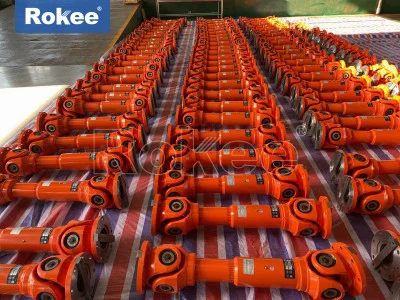
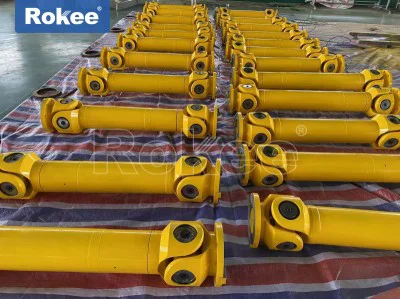
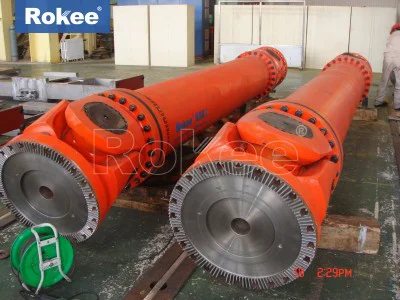
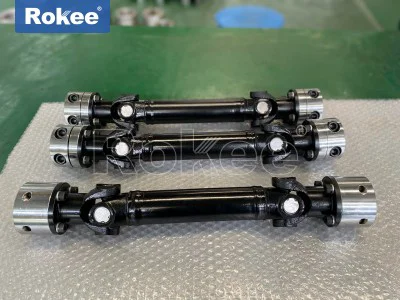
Cardan Coupling Spline Connection
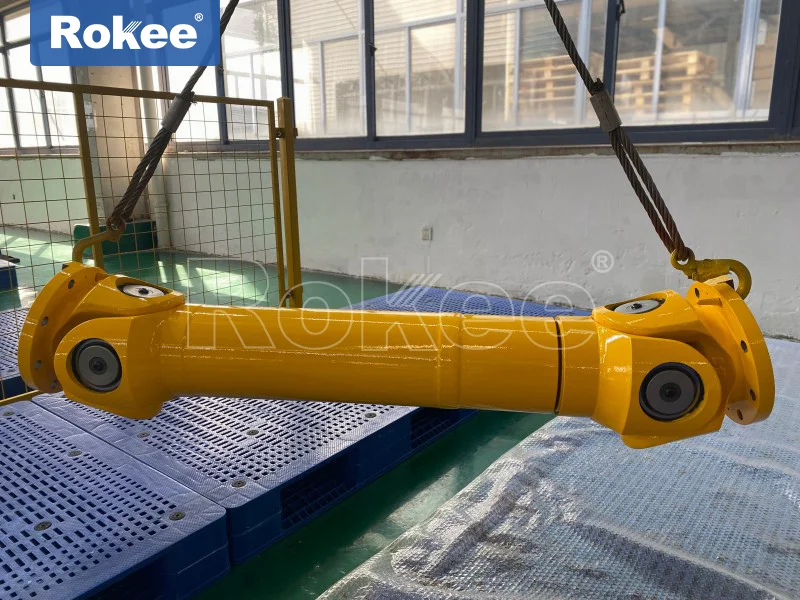
In the intricate ecosystem of mechanical power transmission, the seamless transfer of torque and rotational motion between disjointed shafts stands as a fundamental requirement for diverse industrial and mechanical systems. Among numerous connecting structures, cardan coupling integrated with spline connection has emerged as a highly reliable and adaptable mechanical combination, which ingeniously merges the angular compensation capability of cardan coupling with the axial displacement tolerance and high torque transmission performance of spline connection. This composite structural form has become an indispensable core component in various mechanical equipment that requires flexible power transmission, effectively solving common technical bottlenecks such as shaft misalignment, axial position deviation and variable-angle motion transmission in mechanical operation. Unlike single connecting structures that can only adapt to a single motion state, the integration of cardan coupling and spline connection achieves complementary advantages in mechanical performance, enabling the transmission system to maintain stable operating conditions under complex working conditions including vibration, displacement and angle deflection.
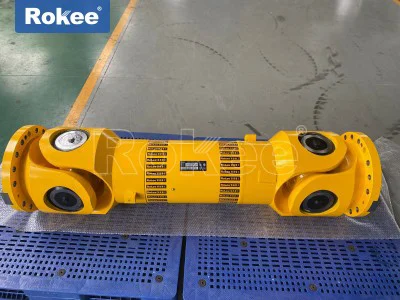
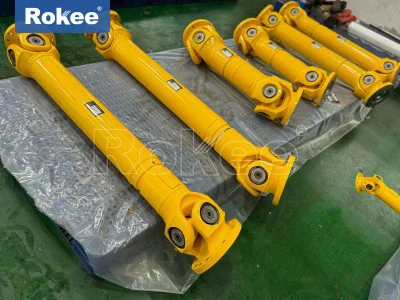
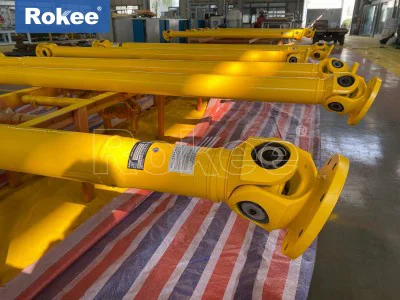
The basic composition of cardan coupling spline connection includes two core functional parts, namely the cardan joint assembly and the spline connecting pair, along with auxiliary supporting components such as bearing parts, sealing structures and connecting forks. The cardan coupling is mainly composed of universal joint forks and a cross shaft, where the cross shaft acts as the central rotating hinge to connect two groups of universal joint forks. This structural design allows the two connected shafts to form a certain deflection angle in space, realizing non-collinear power transmission. The internal rolling bearing components fitted on the journal of the cross shaft can reduce friction resistance during relative rotation between the universal joint forks and the cross shaft, lowering mechanical wear while improving rotation flexibility. The spline connection part consists of an external spline shaft and an internal spline sleeve, which adopt a tooth-shaped meshing structure to realize shaft-to-sleeve connection. The evenly distributed spline teeth on the shaft body can uniformly disperse torque on each tooth surface, avoiding local stress concentration caused by torque transmission, and the sliding fit between the external spline and the internal spline provides a controllable axial displacement range for the transmission shaft. All structural components are mostly made of high-strength alloy steel with excellent hardness and toughness, which can withstand cyclic load impact and long-term friction consumption in harsh working environments.
From the perspective of working mechanism, the cardan coupling and spline connection undertake different transmission tasks and coordinate with each other to complete power delivery. When the mechanical equipment is started, the driving shaft transmits rotational torque to the driven shaft through the meshing of spline teeth. The tight fit between spline teeth ensures no relative circumferential sliding during torque transmission, maintaining high transmission efficiency and rotational synchronization. In the process of equipment operation, affected by road vibration, mechanical deformation or installation errors, the relative position of the driving shaft and the driven shaft will change dynamically. At this time, the spline pair will generate tiny axial sliding to compensate for the axial distance deviation between the shafts, preventing additional extrusion stress from accumulating at the shaft connection. For the angular deviation between shafts caused by mechanical swing or position adjustment, the cardan coupling relies on the rotational deflection of the cross shaft to realize angle adaptation. Within the allowable deflection angle range, the universal joint forks at both ends rotate around the cross shaft to adjust the spatial angle, ensuring continuous torque transmission between non-parallel and non-collinear shafts. Although a single cardan coupling has the characteristic of unequal instantaneous angular velocity transmission, the combined structure with double universal joints can effectively offset the velocity fluctuation, realizing approximate constant-speed power transmission and reducing rotational vibration of the transmission system.
The superior mechanical properties of cardan coupling spline connection stem from its unique structural design and reasonable mechanical matching. In terms of torque transmission capacity, the spline connection adopts multi-tooth simultaneous meshing, which has a larger contact area compared with ordinary key connection structures. This structural feature enables it to bear higher torsion load, and the uniform stress distribution on the tooth surface avoids tooth breakage or plastic deformation under high torque. In terms of displacement compensation performance, the composite structure takes into account both axial linear compensation and angular deflection compensation. The axial sliding range of the spline pair can adapt to the thermal expansion and cold contraction of the shaft body during equipment operation as well as the tiny displacement generated by mechanical vibration, while the cardan coupling can adapt to the spatial angle change of the shaft body within a specific range, effectively eliminating the transmission obstacle caused by shaft misalignment. In addition, the overall structural compactness of the combination is prominent. The integrated design of spline and coupling saves the installation space of the transmission system, which is convenient for layout in narrow mechanical cavities. The rolling friction formed by the internal bearing components of the cardan coupling and the smooth matching of the spline tooth surface greatly reduce the friction coefficient during operation, lowering energy consumption and mechanical heat generation.
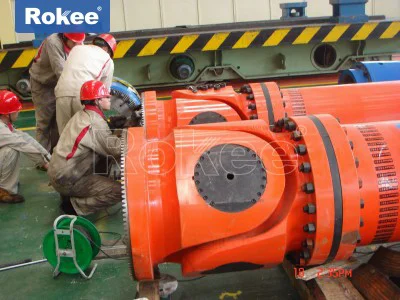
This composite connecting structure has been widely applied in multiple industrial fields relying on its comprehensive performance advantages, covering transportation machinery, engineering equipment, mining machinery and general industrial transmission equipment. In transportation machinery represented by rear-wheel-drive vehicles, the cardan coupling spline connection is installed between the transmission and the drive axle. During vehicle driving, the jolt of the body caused by uneven roads will change the relative angle and axial distance between the transmission shaft and the drive axle. The spline pair realizes axial telescopic compensation, and the cardan coupling adapts to the angle change, ensuring stable power transmission from the engine to the driving wheels. In heavy engineering machinery such as loaders and excavators, the working mechanism needs to frequently adjust the working angle and bear strong impact load. The high torque resistance of the spline connection and the flexible angle adjustment capability of the cardan coupling can adapt to the complex and changeable working postures of the equipment, improving the operating stability of the hydraulic transmission system. In mining and aggregate processing machinery, vibration screening equipment operates with high-frequency vibration for a long time, and the connecting shaft is prone to position offset. The composite connection structure can resist vibration interference, maintain the stability of the power transmission chain, and ensure the continuous operation of material screening and classification work.
Despite the mature application technology, the cardan coupling spline connection still faces inevitable wear and aging problems in long-term service, and the main failure forms include spline tooth surface wear, bearing fatigue damage, cross shaft abrasion and sealing failure. The frequent axial sliding of the spline pair will produce friction scratches on the tooth surface, and the metal fatigue caused by long-term cyclic torque will lead to tooth surface peeling and deformation. The rolling bearings inside the cardan coupling are prone to pitting and wear on the rolling surface under high-speed rotation and heavy load, which will increase the rotation resistance of the universal joint and cause abnormal noise. In harsh working environments with dust, moisture and corrosive media, the sealing structure is easy to age and fail, resulting in impurities entering the internal matching gap, aggravating component wear and even causing jamming failure. To extend the service life of the composite connection structure, reasonable lubrication treatment is essential. High-viscosity lubricating grease can form a protective film on the spline tooth surface and the bearing contact surface, reducing direct metal friction. Meanwhile, optimizing the surface treatment process of components, such as carburizing quenching and anti-corrosion coating, can improve the surface hardness and environmental adaptability of parts.
With the continuous upgrading of modern mechanical manufacturing technology, the optimization and improvement of cardan coupling spline connection are also advancing synchronously. In terms of material optimization, new alloy materials with higher strength and better wear resistance are gradually replacing traditional carbon steel, which can reduce the self-weight of components while improving load-bearing capacity and fatigue resistance. In terms of structural optimization, the tooth profile of spline teeth is optimized to a curved transition structure, which reduces stress concentration at the tooth root and improves the meshing stability of the spline pair. The internal bearing structure of the cardan coupling adopts a more compact rolling element arrangement to expand the allowable deflection angle and enhance the angle adaptation range. In terms of processing technology, precision forging and CNC finishing technologies are widely used in component production, effectively controlling the machining tolerance of spline tooth surface and universal joint hinge gap, improving the matching precision of the overall structure. In addition, the integrated modular design has become a mainstream development trend. The cardan coupling and spline connection are prefabricated into an integral assembly, which simplifies the installation and disassembly process and reduces the maintenance difficulty of mechanical equipment.
In the whole mechanical transmission industry, the technical value of cardan coupling spline connection lies in its excellent comprehensive adaptability, which fills the performance gap of single connecting structure in complex working conditions. It not only retains the high torque transmission advantage of spline connection but also inherits the flexible angle adjustment characteristic of cardan coupling, providing a reliable connecting solution for mechanical systems with variable displacement and variable angle transmission requirements. In the future, with the development of intelligent manufacturing and high-end mechanical equipment, the performance requirements for transmission connecting components will continue to improve, and this composite structure will be further optimized in terms of lightweight design, intelligent wear monitoring and extreme environment adaptability. As a basic and key mechanical component, cardan coupling spline connection will continue to play an irreplaceable role in industrial production, transportation engineering and mechanical manufacturing, providing stable and efficient power transmission guarantee for various mechanical systems.