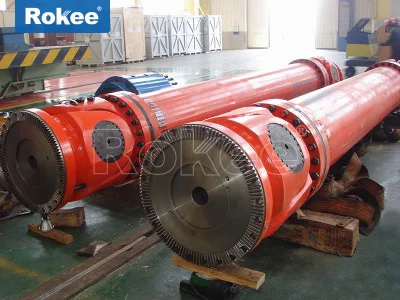
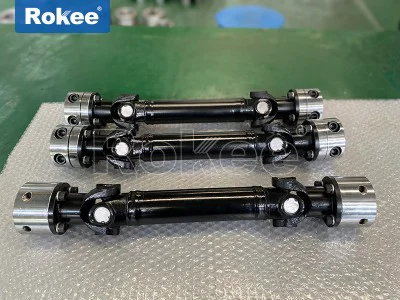
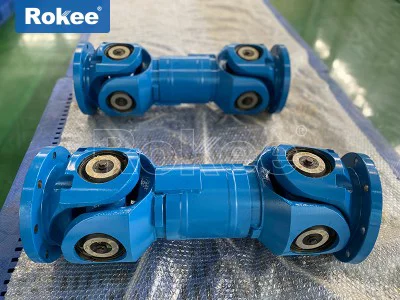
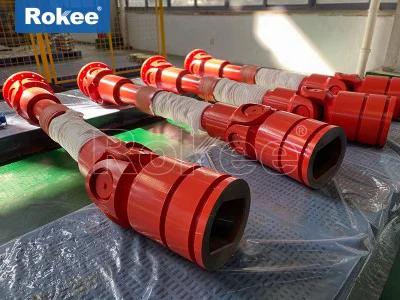
Universal Joint Shafts
Universal joint shaft is a mechanical device that achieves non concentric axis power transmission through a hinge structure, and its core function is to compensate for the angular deviation and position offset between two axes.
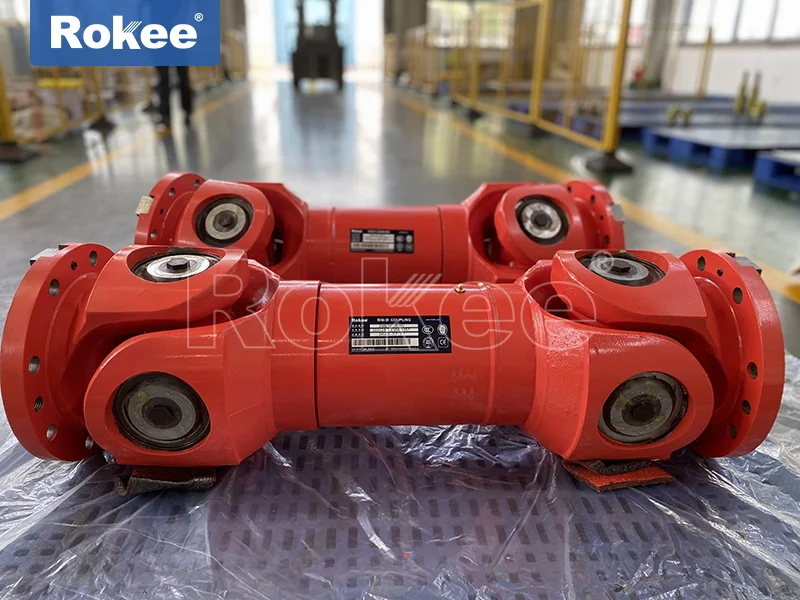
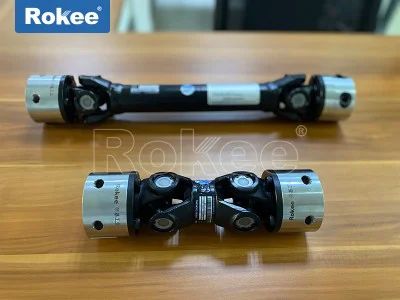
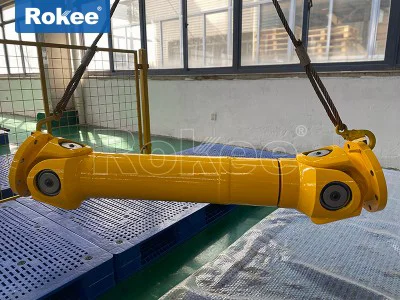
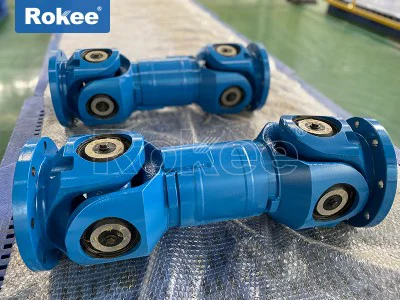
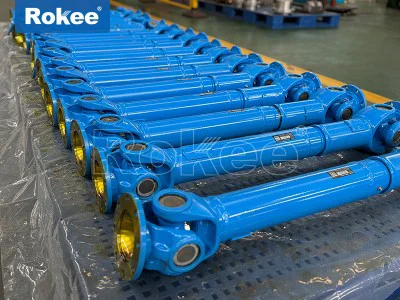
A typical structure includes components such as a cross shaft, bearing sleeve, flange fork, etc., which offset installation errors through relative motion of the components and are suitable for working conditions with axial/radial/angular composite displacement.
Mainstream type
Cross axis universal joint
Adopting a cross cross axis structure, it has a high load-bearing torque and low cost, but requires regular lubrication. The SWC series integral fork design increases the bearing life by 30%.Ball cage universal joint
Spherical raceway transmission ensures a speed fluctuation rate of less than 1%, suitable for high-speed scenarios.Double universal joint
Realize complete constant speed transmission through the design of intermediate shaft equal angle.Ball joint universal joint
The integral connecting sleeve structure increases the radial bearing capacity by 52%.
A universal joint shaft, commonly referred to as a U-joint shaft or Cardan shaft, stands as one of the most fundamental and indispensable mechanical components in modern power transmission systems. Designed to bridge the gap between two rotating shafts that are not aligned along a single straight axis, it enables the seamless transfer of torque and rotational motion even when the shafts exhibit angular misalignment, axial displacement, or combined positional deviations. This unique functionality has cemented its role across countless industrial, automotive, aerospace, and marine applications, where rigid shaft couplings would fail to operate effectively or cause catastrophic damage to connected machinery. Unlike fixed couplings that demand perfect shaft alignment, the universal joint shaft introduces flexibility into transmission systems, absorbing minor positional shifts, reducing mechanical stress, and extending the service life of adjacent components such as motors, gearboxes, and driven equipment.
At its core, the structural design of a universal joint shaft is engineered for durability, efficient power transfer, and adaptive movement, with variations tailored to specific load capacities and operating conditions. The most prevalent and widely used configuration is the cross-type universal joint shaft, also known as the Hooke joint, which features a straightforward yet robust assembly. This structure primarily consists of two yoke-shaped end fittings—one attached to the driving shaft and the other to the driven shaft—and a central cross-shaped spindle, or trunnion, that connects the two yokes at a 90-degree angle to each other. To minimize friction and maximize rotational efficiency, precision needle roller bearings are installed between the cross spindle and the inner walls of the yoke sockets; these bearings reduce sliding resistance, prevent premature wear, and ensure smooth articulation as the joint moves through its angular range. Many high-performance cross-type shafts also incorporate internal lubrication passages within the cross spindle, allowing for consistent grease distribution to the bearing surfaces, alongside protective dust boots or sealing rings that shield the internal components from contaminants such as dust, moisture, dirt, and debris. This basic cross-type structure is celebrated for its simplicity, ease of manufacturing, and exceptional load-bearing capacity, making it the go-to choice for heavy-duty and general-purpose transmission tasks. Beyond the cross-type design, specialized universal joint shafts feature modified structures to address specific operational needs, such as constant velocity joints that eliminate rotational speed fluctuations, flexible joint shafts with elastic intermediate elements, and double-jointed shafts for extended misalignment compensation. Each structural variation retains the core purpose of transmitting rotary motion across misaligned shafts but refines components to optimize performance for unique operating environments, whether that involves high-speed rotation, heavy impact loads, or tight spatial constraints.
The performance of a universal joint shaft is defined by a set of critical metrics that dictate its suitability for different applications, with each attribute directly tied to its structural design and material selection. Foremost among these is torque transmission capacity, which refers to the maximum rotational force the shaft can reliably transfer without deformation, breakage, or performance degradation. This metric is heavily influenced by the diameter and material of the cross spindle, the quality of the bearings, and the overall rigidity of the yoke assemblies; heavy-duty universal joint shafts are crafted from high-strength alloy steels to handle extreme torque loads in industrial machinery, while lighter-duty versions use carbon steel or engineered alloys for moderate-load scenarios. Angular misalignment tolerance is another pivotal performance trait, representing the maximum angle between the driving and driven shafts that the joint can accommodate while maintaining smooth power transfer. Standard cross-type universal joints typically handle angular offsets ranging from 15 to 25 degrees, while specialized constant velocity joints can manage larger angles, often exceeding 30 degrees, without compromising operational stability. Speed capability is equally vital, as universal joint shafts must operate efficiently across low, medium, and high rotational speeds without generating excessive vibration, heat, or noise. Non-constant velocity joints, such as the basic cross-type, may produce minor rotational speed fluctuations at higher angles and speeds, leading to torsional vibration, which is why they are often paired in dual-joint setups to counteract this effect and achieve near-uniform rotation. Constant velocity universal joints, by contrast, are engineered to deliver consistent rotational speed between input and output shafts regardless of operating angle, making them ideal for high-speed applications where smoothness is paramount. Additional performance characteristics include fatigue resistance, which determines the shaft’s ability to withstand repeated cyclic loading without cracking or failing, and operational longevity, which is enhanced by quality bearings, effective sealing, and proper lubrication. The best-performing universal joint shafts strike a balance between these metrics, adapting to the unique stresses of their intended use—whether that involves sustained heavy loads, rapid speed changes, frequent angular adjustments, or exposure to harsh environmental conditions.
Universal joint shafts are categorized into distinct types based on structural design, operational principles, and performance capabilities, each tailored to address specific transmission challenges and application requirements. The primary classification divides these shafts into rigid universal joint shafts and flexible universal joint shafts, with further subcategories within each group to refine functionality. Rigid universal joint shafts are the most common variety, constructed from rigid metal components without elastic elements, and are split into non-constant velocity and constant velocity subcategories. Non-constant velocity rigid shafts, dominated by the cross-type Hooke joint, are valued for their high load capacity, straightforward design, and cost-effectiveness, though they exhibit slight speed variation at operating angles. They are most effective when used in pairs, with the two joints positioned to cancel out speed fluctuations, ensuring relatively smooth power transfer in medium to heavy-duty setups. Constant velocity rigid universal joint shafts, including ball-type and cage-type designs, feature a more intricate internal structure with precision ball bearings that maintain a consistent angular relationship between input and output shafts, eliminating speed variation entirely. These shafts excel in high-speed, high-precision applications where smooth rotation is non-negotiable, even at significant misalignment angles. Flexible universal joint shafts, on the other hand, integrate elastic components such as rubber, polyurethane, or flexible metal bellows between the joint and the shaft body, introducing a degree of torsional flexibility. This flexibility allows them to absorb vibration, dampen shock loads, and compensate for minor axial, angular, and radial misalignments simultaneously, though they typically have lower torque capacity compared to rigid shafts. Further classification can be based on application-specific design features, such as single-joint shafts for simple misalignment scenarios, double-joint shafts for extended offset compensation, telescopic universal joint shafts that adjust for axial length changes, and heavy-duty reinforced shafts for extreme industrial loads. Each type is engineered to prioritize specific performance traits: some prioritize maximum torque, others prioritize high-speed smoothness, and some prioritize vibration damping, ensuring there is a universal joint shaft variant for nearly every power transmission need.
The versatility of universal joint shafts is reflected in their extensive range of applications across nearly every sector that relies on mechanical power transmission, with each use case leveraging the component’s unique ability to transfer motion across misaligned shafts. In the automotive industry, universal joint shafts are integral to vehicle driveline systems, serving as the critical link between the transmission and the drive axles. In rear-wheel-drive and four-wheel-drive vehicles, propeller shafts equipped with universal joints transmit power from the gearbox to the rear differential, accommodating the constant angular changes caused by suspension movement as the vehicle travels over uneven surfaces. Front-wheel-drive vehicles rely heavily on constant velocity universal joint shafts for the drive axles, as these joints enable smooth power delivery to the front wheels even during sharp turns, where the angle between the transmission and the wheel hubs shifts dramatically. Beyond the main driveline, universal joints are also used in automotive steering systems, connecting the steering wheel to the steering gear to ensure precise and responsive control, regardless of minor positional shifts between components. In heavy commercial vehicles such as trucks, buses, and construction equipment, heavy-duty cross-type universal joint shafts are employed to handle the high torque loads generated by large diesel engines, providing reliable power transfer in rugged operating conditions.
Industrial machinery represents another major domain for universal joint shaft applications, where these components facilitate power transfer in a wide array of manufacturing and processing equipment. In metalworking machinery, including lathes, milling machines, and press brakes, universal joint shafts connect motor drives to rotating tool heads or worktables, compensating for misalignment caused by machine vibration or assembly tolerances and ensuring consistent cutting and forming performance. Conveyor systems, which form the backbone of material handling in factories, warehouses, and mining operations, use universal joint shafts to link drive motors to conveyor rollers, accommodating slight misalignments in long conveyor lines and maintaining smooth material flow. Heavy industrial equipment such as crushers, mixers, pumps, and compressors rely on robust universal joint shafts to transmit high torque from prime movers to the working components, withstanding continuous operation, shock loads, and harsh industrial environments. Agricultural machinery, including tractors, harvesters, and tillers, also depends heavily on universal joint shafts to transfer power from the engine to various attachments such as plows, seeders, and balers, adapting to the uneven terrain and dynamic movement of farm equipment in the field. The adaptability of universal joint shafts makes them indispensable in industrial settings, where machinery often operates under variable loads and imperfect alignment conditions.
Beyond automotive and industrial use, universal joint shafts play vital roles in aerospace, marine, and precision engineering applications, where performance and reliability are of the utmost importance. In aerospace systems, lightweight yet high-strength universal joint shafts are used in flight control mechanisms, transmitting precise rotational motion from cockpit controls to ailerons, rudders, and elevators, allowing for accurate aircraft maneuvering even under the structural flexing that occurs during flight. These shafts are manufactured from premium lightweight alloys to meet strict weight and durability requirements, ensuring consistent performance in extreme temperature and pressure conditions. Marine vessels, from small boats to large ships, utilize universal joint shafts in propulsion and steering systems, connecting the engine to the propeller shaft and compensating for hull flexing and shaft misalignment caused by wave impact and vessel movement. They are also used in marine auxiliary equipment such as winches and pumps, providing reliable power transfer in the corrosive marine environment. In precision engineering and robotics, compact, high-precision universal joint shafts enable smooth, multi-axis movement in robotic arms, automated assembly systems, and medical devices, where minimal backlash and precise motion control are critical. Even in smaller-scale applications, such as household appliances, power tools, and recreational equipment, universal joint shafts are used to transmit motion efficiently in compact, space-constrained designs, demonstrating their ubiquity across both heavy-duty and light-duty mechanical systems.
The enduring relevance of universal joint shafts stems from their unmatched ability to solve a fundamental mechanical challenge: transmitting rotary power across non-aligned shafts with efficiency and reliability. While advancements in materials science and engineering have led to incremental improvements in their design—such as enhanced bearing technologies, corrosion-resistant coatings, and optimized structural geometries—the core purpose and operational principles of universal joint shafts remain unchanged. Their simple yet effective construction, combined with diverse performance profiles and wide-ranging applicability, ensures that they will continue to be a cornerstone of power transmission systems for years to come. Whether supporting the operation of a passenger vehicle, a heavy industrial machine, a sophisticated aerospace system, or a precision robotic device, the universal joint shaft delivers consistent, adaptable performance that keeps mechanical systems running smoothly. By understanding the intricate relationship between their structure, performance attributes, and classification, engineers and designers can select the optimal universal joint shaft for any given application, maximizing efficiency, minimizing wear, and ensuring the long-term reliability of the entire mechanical assembly.