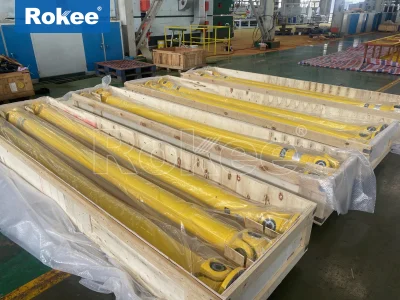
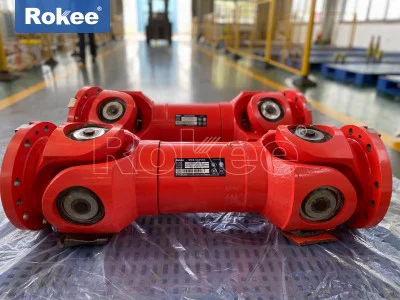
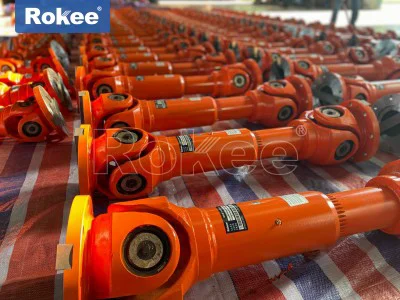
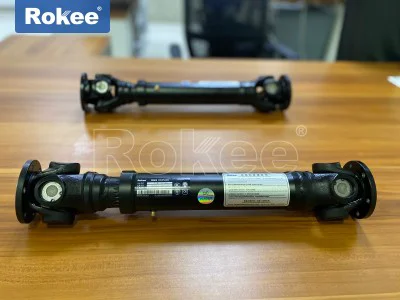
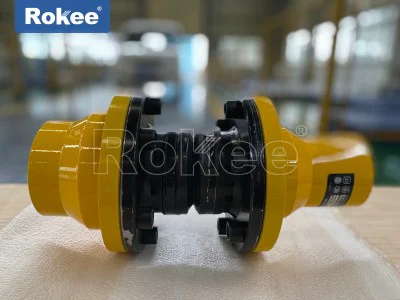
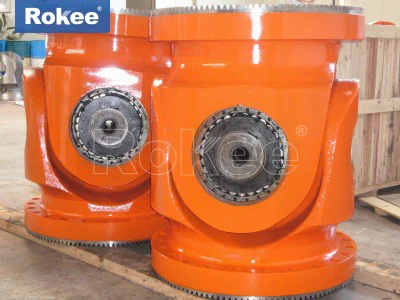
SWC Cardan Shafts
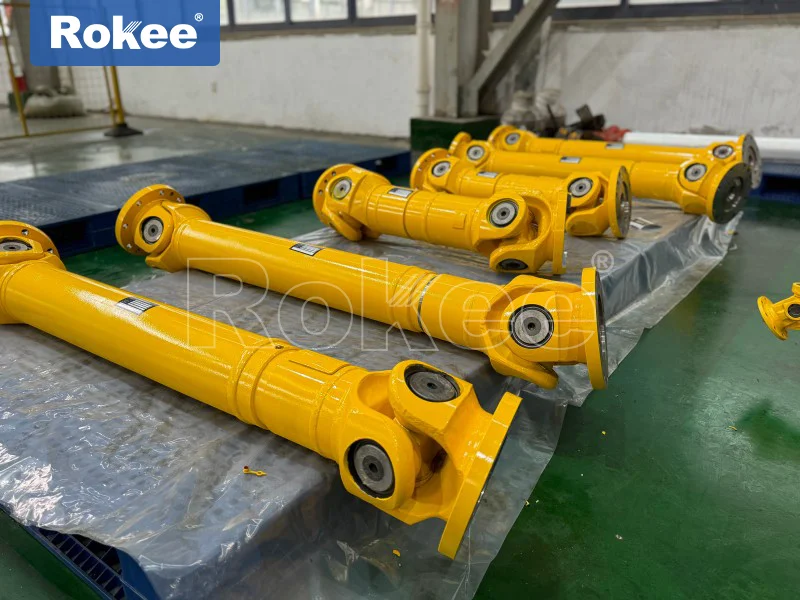
The SWC cardan shaft adopts an integral fork head without bolt connection design, completely eliminating the risk of failure of traditional bolt clamping structures.
Technical Features
Angle compensation capability: The SWC type has an axis bending angle of 15 ° -25 °, and the SWP type can reach 10 °, adapting to axis deviation under complex working conditions
Torque transmission performance: nominal torque coverage of 30000N · m, allowable speed up to 3000r/min
Material process: 35CrMo alloy steel quenching and tempering treatment is adopted, and the cross shaft is high-frequency quenched with 20CrMnTi material, which increases the fatigue life by 30% -50%
Transmission efficiency: up to 98% -99.8%, significant energy-saving effect during high-power transmission
SWC cardan shaft structure type
BH type: standard telescopic welding type, metallurgical rolling mill, mining conveying system
BF type: standard telescopic flange type, ship propulsion system, engineering vehicle
CH type: long telescopic welding type, paper making machinery with large axial displacement
WH type: Non expansion welding type, space limited lifting equipment
WD type: non telescopic short type, with main and auxiliary transmission for rolling mill
Special models such as SWC-WD adopt a compact short design, suitable for heavy-duty scenarios such as rolling mills; The SWC-BH model is equipped with a double-layer spline connection device to avoid gear wear, making it particularly suitable for continuous operations in the metallurgical industry.
It is recommended to prioritize the maintenance free design of SWC-BH/BF type for overloaded equipment, while the economical WH/WD scheme can be considered for intermittent operation scenarios. The specific selection requires a comprehensive evaluation of factors such as peak torque, types of environmental pollutants, and maintenance resources.
The SWC cardan shaft is a critical component in mechanical transmission systems, designed to address the challenge of torque transfer between two shafts that are not aligned on the same axis, have significant angular offsets, or require axial displacement compensation. Unlike conventional couplings that operate optimally only when shafts are perfectly collinear, the SWC cardan shaft leverages a sophisticated structural design to ensure reliable, efficient power transmission even under harsh and complex working conditions. Its versatility and robustness have made it an indispensable part of various industrial sectors, from heavy machinery to precision equipment, where stable and flexible torque transfer is essential for operational efficiency and safety. To fully understand the value of the SWC cardan shaft, it is necessary to explore its structural composition, core performance characteristics, diverse types, and wide-ranging applications, as each aspect contributes to its unique ability to adapt to different working environments and meet varied transmission requirements.
The structure of the SWC cardan shaft is meticulously engineered to balance strength, flexibility, and durability, with each component playing a vital role in ensuring smooth and reliable torque transfer. At the core of its design is the cross shaft assembly, which serves as the central pivot enabling angular compensation. The cross shaft, typically made of high-strength alloy steel经过 precision forging and heat treatment, features four trunnions that connect to the yokes at both ends. These trunnions are equipped with needle bearings, which reduce friction during rotation and allow the cross shaft to swing freely as the angle between the connected shafts changes. The needle bearings are enclosed within bearing seats, which are secured to the yokes to prevent dust, debris, and moisture from entering, thus extending the service life of the assembly. The yokes, also known as fork joints, are divided into two main types: integral and split, depending on the design requirements. Integral yokes are forged as a single piece, offering higher structural rigidity and resistance to torque, making them suitable for heavy-duty applications. Split yokes, on the other hand, are composed of two separate parts joined by fasteners, facilitating easier installation and maintenance in tight spaces where disassembly of the entire shaft is not feasible.
Another key structural component of the SWC cardan shaft is the telescopic spline assembly, which enables axial displacement compensation. This assembly consists of a spline shaft and a spline sleeve, with the spline shaft sliding inside the sleeve to adjust the overall length of the cardan shaft. The spline teeth are precision machined to ensure a tight fit, minimizing backlash and ensuring efficient torque transfer while allowing smooth axial movement. Some advanced designs feature double-sleeve spline structures, with an outer involute spline and an inner rectangular spline, which enhances wear resistance and reduces the risk of failure due to spline damage. The connection between the yokes and the spline assembly or the driven/driving shafts is typically achieved through welding or flange connections, depending on the application requirements. Welded connections offer higher structural integrity and load-bearing capacity, while flange connections provide greater flexibility for assembly and disassembly, making them ideal for applications where regular maintenance is required.
The performance of the SWC cardan shaft is defined by a set of key characteristics that make it suitable for a wide range of industrial applications, particularly those involving heavy loads, high speeds, and variable operating conditions. One of its most notable performance features is its excellent angular compensation capability. A single SWC cardan shaft can typically compensate for angular offsets between 15° and 25°, and when configured as a double cardan shaft (two cardan joints connected in series with a middle shaft), the angular compensation range can be extended to 40° to 45°. This ability to accommodate significant angular misalignment makes it ideal for use in equipment where shafts are not perfectly aligned due to installation errors, structural deformation, or dynamic movement during operation. Additionally, the telescopic spline assembly allows for axial displacement compensation of up to several hundred millimeters, depending on the model, which helps to absorb thermal expansion and contraction of shafts during operation, as well as compensate for installation errors and positional changes.
High load-bearing capacity is another critical performance attribute of the SWC cardan shaft. Thanks to the use of high-strength alloy steel materials and precision forging and heat treatment processes, the SWC cardan shaft can transmit torque ranging from a few thousand Newton-meters to over 10,000 Newton-meters, making it suitable for heavy-duty applications such as metallurgy, mining, and shipbuilding. The integral yoke design, in particular, enhances the shaft’s resistance to torsion and impact, allowing it to withstand the sudden load changes and shock loads commonly encountered in these industries. Another important performance characteristic is its high transmission efficiency, which typically ranges from 98% to 99.8%. This high efficiency is achieved through the precision machining of components, the use of low-friction needle bearings, and the minimization of backlash in the spline assembly, which reduces energy loss during torque transfer. In large-scale industrial systems, this high efficiency translates to significant energy savings and reduced operational costs over time.
The SWC cardan shaft also exhibits excellent stability and low noise during operation. The precision machining of the cross shaft, yokes, and spline assembly ensures that the components fit together seamlessly, minimizing vibration and noise. The use of high-quality lubricants in the needle bearings further reduces friction and wear, contributing to smooth operation and a longer service life. Additionally, the sealed bearing seats prevent the ingress of contaminants, which can cause premature wear and failure of components, ensuring consistent performance even in harsh environments such as dusty mines, humid shipyards, or high-temperature metallurgical plants. The durability of the SWC cardan shaft is further enhanced by its resistance to corrosion and wear, thanks to surface treatments such as carburizing, nitriding, or galvanizing, which protect the components from environmental damage and extend their service life by 30% to 50% compared to conventional couplings.
The SWC cardan shaft is available in a variety of types, each designed to meet specific application requirements based on factors such as load capacity, angular compensation needs, axial displacement, and installation space. The primary classification of SWC cardan shafts is based on their telescopic capability, dividing them into telescopic and non-telescopic types. Telescopic SWC cardan shafts are the most common type, featuring a spline assembly that allows for axial movement, making them suitable for applications where the distance between the driving and driven shafts may change during operation or due to thermal expansion. Within the telescopic category, there are several sub-types, including standard telescopic welded (BH type), long telescopic welded (CH type), and short telescopic welded (DH type) cardan shafts. The BH type is a standard design suitable for most general heavy-duty applications, offering a balance of angular compensation and axial displacement. The CH type features a longer telescopic length, making it ideal for applications where large axial displacement is required, such as in rolling mills and long-distance conveyor systems. The DH type, with its shorter telescopic length, is designed for compact installation spaces where axial displacement requirements are minimal but high load-bearing capacity is still needed.
Non-telescopic SWC cardan shafts, as the name suggests, do not have a telescopic spline assembly and are designed for applications where the distance between the driving and driven shafts is fixed and no axial displacement is required. These include non-telescopic welded (WH type), non-telescopic flange (WF type), and non-telescopic short (WD type) cardan shafts. The WH type is a welded design suitable for fixed-distance applications where high structural rigidity is required, such as in some mining machinery and construction equipment. The WF type features flange connections, making it easy to assemble and disassemble, and is commonly used in ship propulsion systems and industrial pumps. The WD type is a compact, short-length design, ideal for applications with limited installation space, such as in small cranes and precision machinery. In addition to these main types, SWC cardan shafts can also be classified based on their load capacity, with light-duty, medium-duty, and heavy-duty variants. Light-duty SWC cardan shafts are designed for applications with lower torque requirements, such as paper machinery, pumps, and test benches, while medium-duty and heavy-duty variants are used in high-torque applications such as metallurgy, mining, and heavy construction equipment.
The wide range of structural designs and performance characteristics of the SWC cardan shaft makes it suitable for a diverse array of applications across various industrial sectors. One of the most prominent applications is in the metallurgical industry, where it is used in rolling mills, straightening machines, and continuous casting equipment. In rolling mills, for example, the SWC cardan shaft is used to transmit torque between the motor and the rolling rolls, accommodating the angular misalignment and axial displacement caused by the heavy loads and thermal expansion of the rolls during operation. Its high load-bearing capacity and angular compensation capability ensure stable and efficient operation, which is critical for maintaining the quality of the rolled products. In the mining industry, the SWC cardan shaft is used in crushers, conveyor systems, and mining trucks, where it must withstand harsh conditions such as dust, vibration, and shock loads. Its robust construction and sealed bearing design make it resistant to contamination, ensuring reliable performance even in the most demanding mining environments.
The shipbuilding industry is another major user of SWC cardan shafts, where they are used in ship propulsion systems to transmit torque from the engine to the propeller. The ability of the SWC cardan shaft to compensate for angular misalignment and axial displacement is particularly important in ships, as the hull can flex during navigation, causing the engine and propeller shafts to shift relative to each other. The corrosion-resistant surface treatments and sealed components of the SWC cardan shaft make it suitable for use in marine environments, where exposure to saltwater and humidity can cause rapid wear and corrosion. In the construction industry, SWC cardan shafts are used in cranes, excavators, and bulldozers, where they transmit torque between the engine and the hydraulic systems or drive wheels. Their compact design and high load-bearing capacity make them ideal for use in construction equipment, which often operates in tight spaces and under heavy loads.
Beyond these heavy industries, the SWC cardan shaft also finds applications in other sectors such as paper manufacturing, rubber processing, and power generation. In paper mills, it is used in paper machines to transmit torque between the various rollers, accommodating the angular misalignment and axial movement caused by the tension of the paper web. In rubber processing equipment, such as mixing mills and calenders, the SWC cardan shaft ensures smooth and efficient torque transfer, contributing to the quality of the final rubber products. In power generation plants, particularly those using wind turbines or hydroelectric generators, the SWC cardan shaft is used to transmit torque from the turbine to the generator, accommodating the dynamic misalignment caused by wind or water flow variations. Its high efficiency and reliability help to maximize power generation and reduce downtime.
In addition to industrial applications, the SWC cardan shaft is also used in some specialized fields such as amusement rides and wastewater treatment equipment. In amusement rides, such as Ferris wheels and roller coasters, the SWC cardan shaft is used to transmit torque to the rotating components, ensuring smooth and safe operation even when the shafts are misaligned. In wastewater treatment equipment, such as pumps and aerators, the SWC cardan shaft’s resistance to corrosion and contamination makes it suitable for use in wet and harsh environments, ensuring reliable operation of the treatment systems. The versatility of the SWC cardan shaft is further enhanced by its ability to be customized according to specific application requirements, with modifications to the length, diameter, material, and connection type to meet the unique needs of different industries and equipment.
The widespread adoption of the SWC cardan shaft in various industries is a testament to its superior performance, reliability, and versatility. Its unique structural design, which combines the cross shaft assembly for angular compensation and the telescopic spline assembly for axial displacement, addresses the key challenges of torque transfer in misaligned shafts. The high load-bearing capacity, high transmission efficiency, and excellent durability of the SWC cardan shaft make it suitable for use in the most demanding industrial environments, while its diverse range of types ensures that it can be tailored to meet the specific requirements of different applications. As industrial technology continues to advance, the SWC cardan shaft is likely to play an even more important role in mechanical transmission systems, with ongoing improvements in material technology and design further enhancing its performance and expanding its range of applications. Whether in heavy metallurgical plants, remote mining sites, or sophisticated power generation facilities, the SWC cardan shaft remains a critical component that enables reliable and efficient power transmission, supporting the smooth operation of industrial processes around the world.