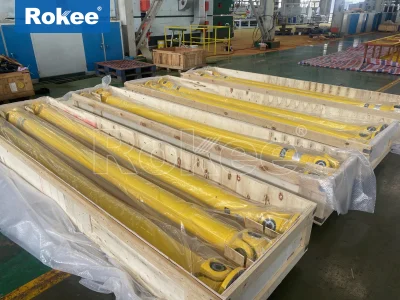
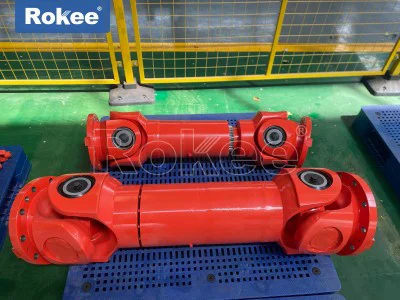
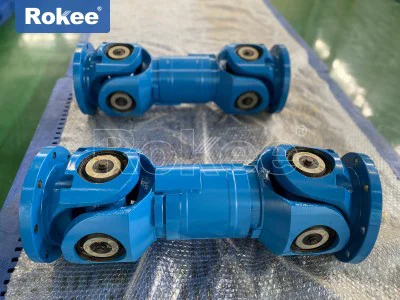
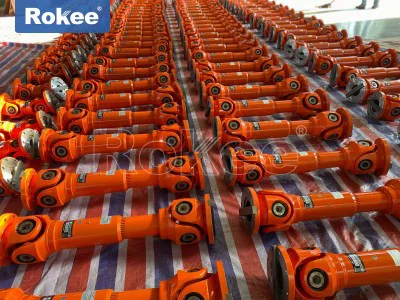
Double Cardan Drive Shaft
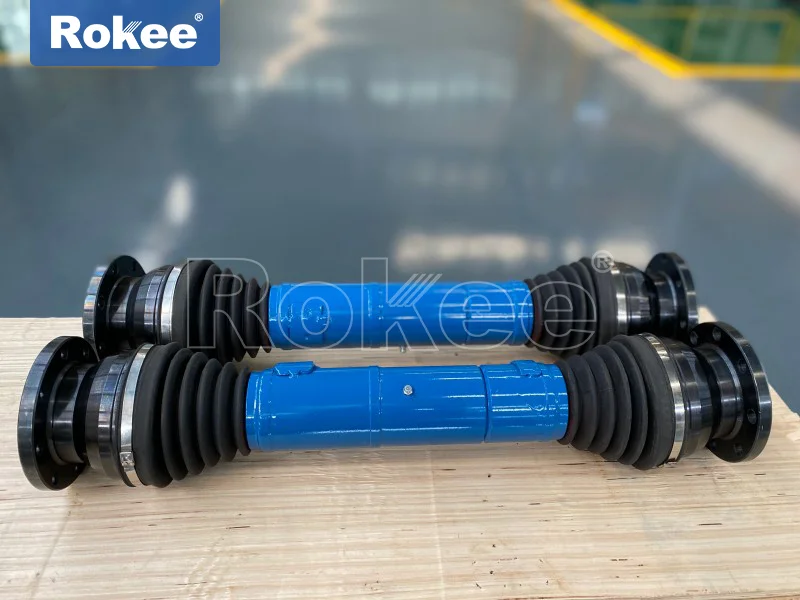
The double cardan drive shaft is a sophisticated mechanical component designed to transmit rotational power and torque between two non-aligned shafts, addressing the limitations of single universal joint drive shafts by minimizing speed fluctuations and vibrations. Unlike simple drive shafts that rely on a single universal joint, the double cardan design incorporates a more intricate arrangement that ensures smoother power transmission even when the input and output shafts are positioned at significant angles relative to each other. This makes it an indispensable component in a wide range of mechanical systems where precision, durability, and reliability are paramount.
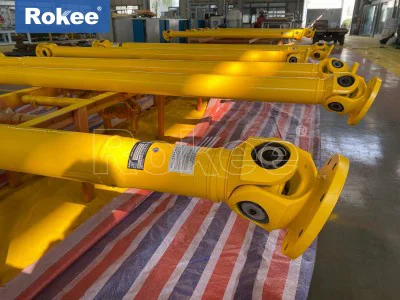
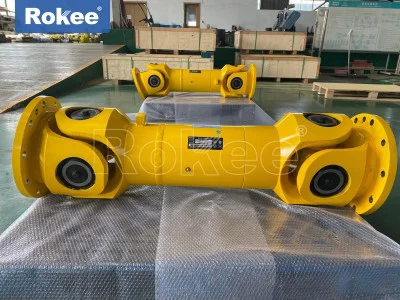
At its core, the double cardan drive shaft consists of several interconnected components that work in harmony to achieve efficient power transmission. The fundamental structure includes two universal joints, also known as cardan joints, connected by an intermediate shaft or centering yoke. Each universal joint comprises a cross-shaped component, often referred to as a cross or spider, with needle bearings mounted at each of its four ends. These needle bearings allow the cross to rotate freely within the yokes, which are attached to the input shaft, intermediate shaft, and output shaft respectively. The intermediate shaft, which links the two universal joints, is typically shorter in length and designed to maintain a precise phase relationship between the two joints—usually 90 degrees out of phase—to cancel out the angular velocity fluctuations that are inherent in single universal joint systems. In many designs, a centering element, such as a spherical needle bearing or a resilient spring component, is integrated to ensure that the input and output shafts maintain equal angles relative to the intermediate shaft, thereby achieving true constant velocity transmission. This centering element also helps to align the assembly and reduce the oscillating moments that can cause bending stresses on the shafts and excessive wear on the bearings. Additionally, the entire assembly is often enclosed in a protective sleeve or boot to prevent contamination from dust, moisture, and other debris, which can degrade the performance and lifespan of the moving components. The materials used in constructing the double cardan drive shaft are carefully selected based on the application requirements, with common materials including high-strength alloy steels, carbon fiber-reinforced polymers, and epoxy resin-infused fabrics, each offering distinct advantages in terms of strength, weight, and durability.
The performance of the double cardan drive shaft is defined by several key characteristics that set it apart from other types of drive shafts, making it suitable for demanding applications. One of its most notable performance attributes is its ability to transmit power at nearly constant velocity, even when operating at large articulation angles. Single universal joints suffer from a phenomenon known as angular velocity fluctuation, where the output shaft speed varies periodically even if the input shaft speed remains constant, especially as the angle between the shafts increases. This fluctuation can cause vibrations, noise, and increased wear on the driveline components. The double cardan design eliminates this issue by using two universal joints phased at 90 degrees and connected by an intermediate shaft, which cancels out the speed variations from each individual joint. This results in a smooth and consistent power transfer, reducing vibrations and improving the overall stability of the mechanical system. Another critical performance characteristic is its high torque-carrying capacity, which allows it to handle the high power outputs required in heavy-duty applications such as trucks, agricultural machinery, and industrial equipment. The robust construction of the universal joints, intermediate shaft, and yokes ensures that the drive shaft can withstand extreme torque loads without deformation or failure. Additionally, the double cardan drive shaft exhibits excellent durability and resistance to wear, thanks to the use of high-quality materials and precision-engineered components such as needle bearings, which reduce friction between moving parts. The design also allows for a high degree of flexibility, enabling it to accommodate not only angular misalignment but also minor axial and radial movements between the input and output shafts, which is particularly important in vehicles with independent suspension systems that experience vertical wheel movement during operation. Furthermore, advancements in material science have led to the development of lightweight double cardan drive shafts using composite materials, which offer a significant reduction in weight compared to traditional steel designs while maintaining or even improving strength and durability. These lightweight designs contribute to improved fuel efficiency in automotive applications and reduced fatigue on the driveline components.
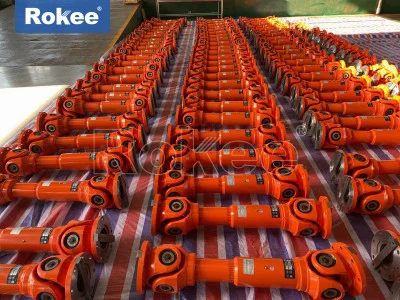
There are several types of double cardan drive shafts, each designed to meet the specific requirements of different applications, varying in terms of construction, design features, and performance capabilities. One common type is the standard double cardan drive shaft, which features a traditional design with two universal joints connected by a solid intermediate shaft and a centering ball joint. This type is widely used in rear-wheel drive and four-wheel drive vehicles, as well as in light to medium-duty industrial equipment, and is known for its reliability and simplicity. Another type is the telescopic double cardan drive shaft, which incorporates a telescopic intermediate shaft that can expand or contract to accommodate changes in the distance between the input and output shafts. This feature is particularly useful in vehicles with long wheelbases or suspension systems that experience significant vertical movement, as it allows the drive shaft to adjust its length without compromising power transmission. The telescopic design typically includes a sliding spline joint that enables the intermediate shaft to extend and retract smoothly, while maintaining the necessary phase relationship between the two universal joints. A third type is the composite double cardan drive shaft, which uses composite materials such as carbon fiber-reinforced polymers or epoxy resin-infused fabrics in its construction. These composite drive shafts offer several advantages over traditional steel designs, including lower weight, higher strength-to-weight ratio, improved corrosion resistance, and reduced vibration damping. They are commonly used in high-performance vehicles, racing cars, and aerospace applications where weight reduction and high performance are critical. Additionally, there is the spring-guided double cardan drive shaft, which replaces the conventional centering ball joint with a resilient spring component positioned between the two universal joints. This design eliminates the need for grease lubrication of the centering element, reducing maintenance requirements and the risk of contamination, while still ensuring proper alignment and constant velocity transmission. Each type of double cardan drive shaft is engineered to address specific challenges, such as weight constraints, maintenance needs, articulation angle requirements, and torque loads, making it essential to select the appropriate type based on the application.
The versatility of the double cardan drive shaft is reflected in its wide range of applications across various industries, where its unique performance characteristics make it an ideal choice for demanding power transmission needs. One of the most common applications is in the automotive industry, where it is used in rear-wheel drive, four-wheel drive, and all-wheel drive vehicles. In these vehicles, the double cardan drive shaft connects the transmission or transfer case to the rear axle or front axle, transmitting power from the engine to the wheels. It is particularly valuable in lifted trucks, off-road vehicles, and performance cars, where large articulation angles are common and smooth power transmission is essential for optimal handling and performance. Off-road vehicles, in particular, benefit from the double cardan drive shaft’s ability to handle extreme angles during suspension travel, ensuring that power is consistently transmitted to the wheels even when traversing rough terrain. Performance cars and racing vehicles often use lightweight composite double cardan drive shafts to reduce weight and improve acceleration, while maintaining the high torque-carrying capacity required for high-speed operation. Beyond passenger vehicles, the double cardan drive shaft is widely used in commercial vehicles such as trucks, buses, and delivery vans, where it handles the high torque loads required for heavy hauling. These commercial applications demand exceptional durability and reliability, and the double cardan design delivers by reducing vibrations and wear on the driveline components, minimizing maintenance costs and downtime.
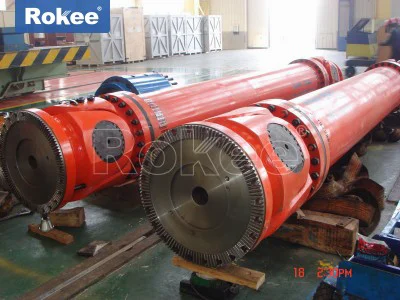
The agricultural industry also relies heavily on double cardan drive shafts for a variety of equipment, including tractors, combine harvesters, forestry vehicles, and agricultural implements. In agricultural machinery, the drive shaft must transmit power between non-aligned components while withstanding harsh operating conditions such as dust, moisture, temperature fluctuations, and heavy loads. Tractors use double cardan drive shafts to connect the engine to the rear axle and to power auxiliary equipment such as hydraulic pumps, harvesters, and timber transporters. Combine harvesters and other agricultural implements require drive shafts that can handle large articulation angles and constant power transmission to ensure efficient operation during harvesting and planting seasons. The durability and resistance to contamination of the double cardan drive shaft make it well-suited for these demanding agricultural applications. In the industrial sector, the double cardan drive shaft is used in a wide range of machinery, including industrial pumps, compressors, generators, conveyors, and rolling mills. These industrial applications often involve high torque loads, high rotational speeds, and significant angular misalignment between shafts, making the double cardan design an ideal solution. For example, in rolling mills, the drive shaft must transmit massive torque to the rollers while accommodating the angular misalignment between the motor and the mill stand, and the double cardan drive shaft’s high torque capacity and constant velocity transmission ensure smooth and efficient operation. In addition, the double cardan drive shaft is used in marine and boating applications, where it connects the engine to the propeller, transmitting power through the hull while accommodating the angular misalignment between the engine and the propeller shaft. The corrosion-resistant materials used in marine-grade double cardan drive shafts ensure that they can withstand the harsh saltwater environment without degradation.
Another important application area for the double cardan drive shaft is in aerospace and defense systems, where precision, reliability, and lightweight construction are critical. In aircraft, the drive shaft is used to transmit power from the engine to various components such as hydraulic pumps, generators, and auxiliary power units. The lightweight composite double cardan drive shafts are particularly well-suited for aerospace applications, as they reduce the overall weight of the aircraft, improving fuel efficiency and performance. In defense vehicles such as tanks, armored personnel carriers, and military trucks, the double cardan drive shaft must withstand extreme operating conditions, including heavy loads, large articulation angles, and harsh environments, while ensuring reliable power transmission. The robust construction and high durability of the double cardan drive shaft make it an essential component in these defense systems. Additionally, the double cardan drive shaft is used in specialized equipment such as robotics, where precise and smooth power transmission is required to control the movement of robotic arms and other components. In robotics, the drive shaft must accommodate small angular misalignments while maintaining constant velocity, ensuring accurate and repeatable motion.
The ongoing development and innovation in the design and materials of double cardan drive shafts continue to expand their applications and improve their performance. Advances in computational tools such as finite element analysis and modal analysis have enabled engineers to optimize the design of double cardan drive shafts, ensuring that they meet the specific performance requirements of each application while minimizing weight and cost. Modal analysis, for example, is used to determine the natural frequencies and mode shapes of the drive shaft, helping to avoid resonance and reduce vibrations at high rotational speeds. Harmonic response analysis is also employed to investigate the drive shaft’s behavior under the influence of torque, ensuring that it can withstand the dynamic loads encountered during operation. The integration of composite materials has been a major area of innovation, with studies demonstrating that composite double cardan drive shafts offer significant performance improvements over traditional steel designs, including a higher safety factor and reduced damage factor. These advancements have made double cardan drive shafts even more versatile, allowing them to be used in increasingly demanding applications where performance, reliability, and efficiency are critical.
In conclusion, the double cardan drive shaft is a highly versatile and efficient mechanical component that plays a critical role in power transmission across a wide range of industries. Its unique structural design, which incorporates two phased universal joints and an intermediate shaft, enables it to transmit power at nearly constant velocity even at large articulation angles, eliminating the speed fluctuations and vibrations associated with single universal joint drive shafts. The key performance characteristics of the double cardan drive shaft, including its high torque-carrying capacity, durability, flexibility, and lightweight options, make it suitable for a diverse array of applications, from automotive and agricultural machinery to industrial equipment, aerospace systems, and robotics. The various types of double cardan drive shafts, each tailored to specific application requirements, ensure that there is a solution available for even the most demanding power transmission needs. As material science and engineering techniques continue to advance, the double cardan drive shaft is likely to become even more efficient, durable, and versatile, further expanding its role in modern mechanical systems and contributing to the development of more reliable and high-performance equipment across all industries.